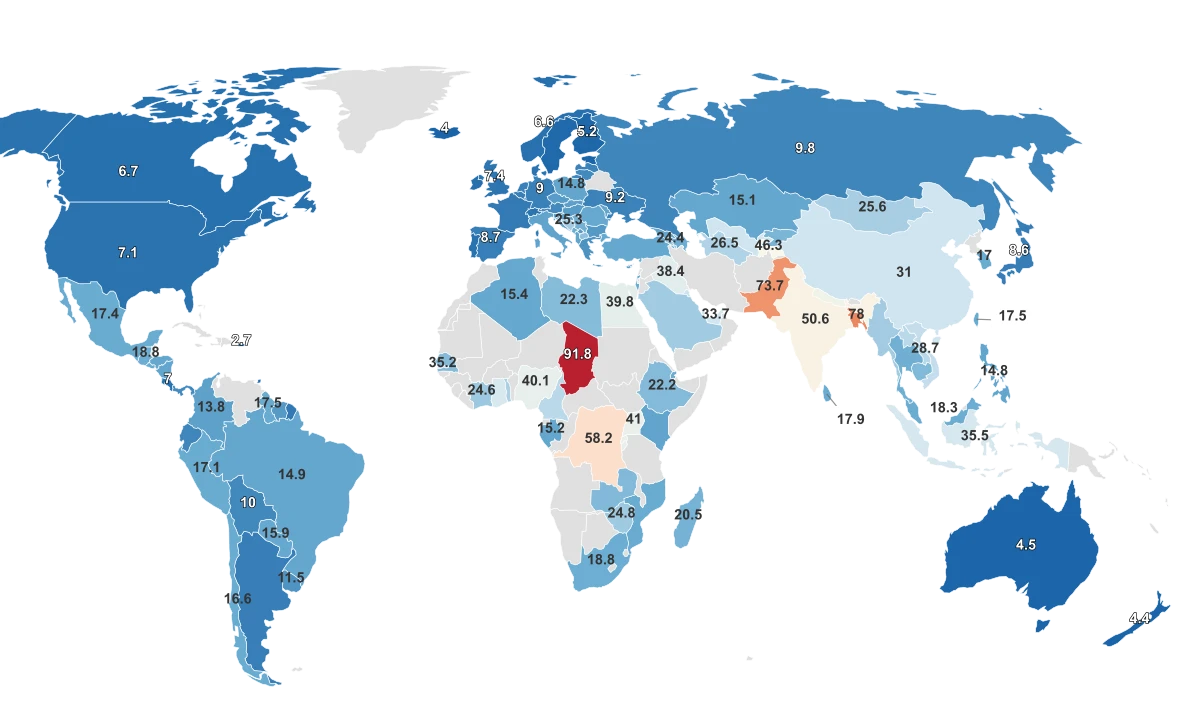
Suicide Rate by Country

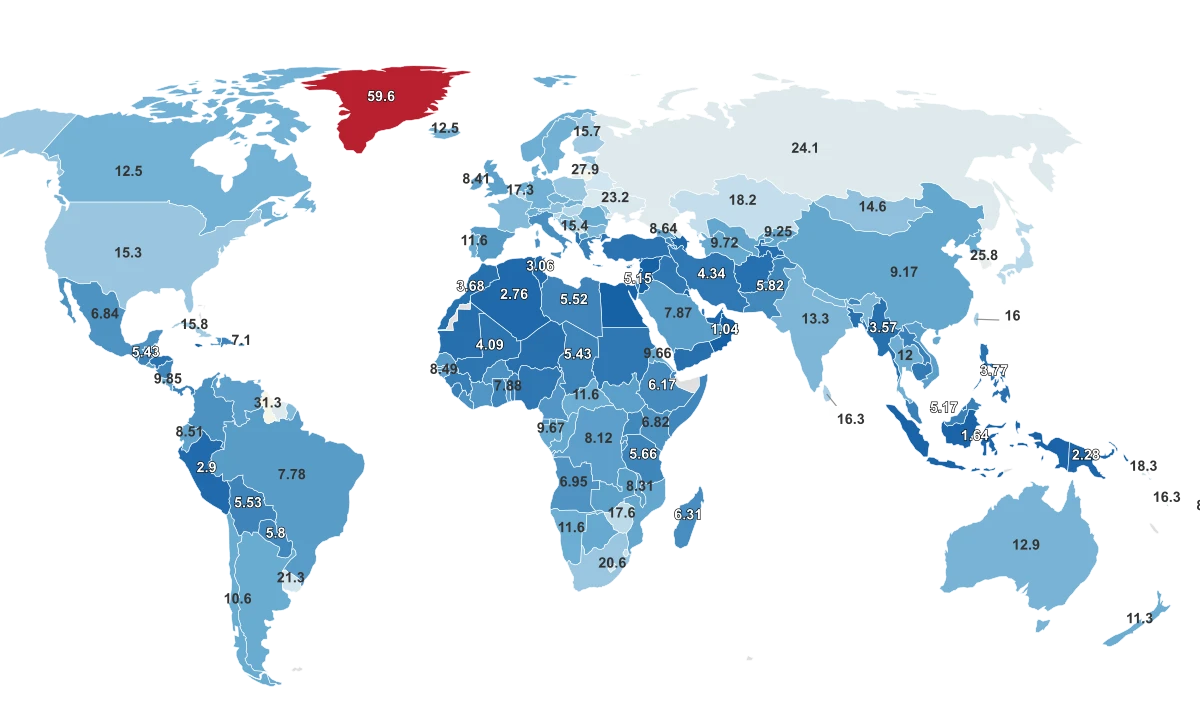
1— |  | Greenland | 59.6per 100k |
2— |  | Guyana | 31.3per 100k-9 (-22%) |
3▲4 |  | Lithuania | 27.9per 100k+1.8 (+6.9%) |
4— |  | South Korea | 25.8per 100k-2.8 (-9.8%) |
5▲4 |  | Russia | 24.1per 100k-1 (-4.0%) |
6— |  | Nauru | 23.6per 100k |
6▲2 |  | Suriname | 23.6per 100k-1.8 (-7.1%) |
8▲3 |  | Ukraine | 23.2per 100k+1.6 (+7.4%) |
9▲3 |  | Uruguay | 21.3per 100k+0.1 (+0.5%) |
10▼9 |  | Lesotho | 20.6per 100k-51.8 (-72%) |
11▲1 |  | Belarus | 20.4per 100k-0.8 (-3.8%) |
12▼6 |  | Micronesia | 20.2per 100k-8 (-28%) |
13— |  | Marshall Islands | 20per 100k |
14▲1 |  | Latvia | 19.4per 100k-0.7 (-3.5%) |
15▼12 |  | Eswatini | 18.4per 100k-11 (-37%) |
16▲12 |  | Solomon Islands | 18.3per 100k+3.6 (+24%) |
17▲3 |  | Kazakhstan | 18.2per 100k+0.6 (+3.4%) |
18▲16 |  | Zimbabwe | 17.6per 100k+3.5 (+25%) |
19▲6 |  | Japan | 17.5per 100k+2.2 (+14%) |
20▼3 |  | Belgium | 17.3per 100k-1 (-5.5%) |
20▼15 |  | Kiribati | 17.3per 100k-11 (-39%) |
22▼6 |  | Slovenia | 17.1per 100k-2.7 (-14%) |
22— |  | Guam | 17.1per 100k |
24▼3 |  | Hungary | 16.9per 100k+0.3 (+1.8%) |
25— |  | Tuvalu | 16.5per 100k |
26▼8 |  | Vanuatu | 16.3per 100k-1.7 (-9.4%) |
26▲9 |  | Sri Lanka | 16.3per 100k+2.3 (+16%) |
28— |  | Taiwan | 16per 100k |
29▲20 |  | Serbia | 15.9per 100k+4.5 (+39%) |
30▲2 |  | Cuba | 15.8per 100k+1.3 (+9.0%) |
31▼6 |  | Finland | 15.7per 100k+0.4 (+2.6%) |
32— |  | Northern Mariana Islands | 15.6per 100k |
32— |  | Niue | 15.6per 100k |
34— |  | Monaco | 15.4per 100k |
34▼20 |  | Montenegro | 15.4per 100k-5.6 (-27%) |
36▼26 |  | South Africa | 15.3per 100k-8.2 (-35%) |
36▼13 |  | United States | 15.3per 100k-0.8 (-5.0%) |
38▼11 |  | Estonia | 15.2per 100k+0.3 (+2.0%) |
38▲12 |  | Poland | 15.2per 100k+3.9 (+35%) |
40— |  | Cape Verde | 15.1per 100k |
41— |  | Palau | 15per 100k |
42▼14 |  | Moldova | 14.9per 100k+0.2 (+1.4%) |
43▼24 |  | Mongolia | 14.6per 100k-3.3 (-18%) |
44▼22 |  | Croatia | 14.3per 100k-2.1 (-13%) |
44▼13 |  | Austria | 14.3per 100k-0.3 (-2.1%) |
46▲30 |  | Trinidad and Tobago | 13.8per 100k+5.1 (+59%) |
47▼11 |  | France | 13.7per 100k-0.1 (-0.7%) |
48▲9 |  | Bulgaria | 13.3per 100k+3.6 (+37%) |
48▼10 |  | India | 13.3per 100k+0.6 (+4.7%) |
50▲17 |  | Nepal | 13.1per 100k+4.1 (+46%) |
51▼11 |  | Australia | 12.9per 100k+0.4 (+3.2%) |
52— |  | Czech Republic | 12.6per 100k |
53▼8 |  | Canada | 12.5per 100k+0.7 (+5.9%) |
53▼9 |  | Iceland | 12.5per 100k+0.6 (+5.0%) |
55▼27 |  | Sweden | 12.3per 100k-2.4 (-16%) |
55▼12 |  | Slovakia | 12.3per 100k+0.2 (+1.7%) |
55▼14 |  | Germany | 12.3per 100k |
58▼19 |  | Samoa | 12.2per 100k-0.4 (-3.2%) |
59▲15 |  | Thailand | 12per 100k+3.2 (+36%) |
60▼28 |  | Switzerland | 11.7per 100k-2.8 (-19%) |
60▼15 |  | Norway | 11.7per 100k-0.1 (-0.8%) |
62▼21 |  | Central African Republic | 11.6per 100k-0.7 (-5.7%) |
62▼14 |  | Portugal | 11.6per 100k+0.1 (+0.9%) |
62▼5 |  | Namibia | 11.6per 100k+1.9 (+20%) |
65▼12 |  | New Zealand | 11.3per 100k+0.3 (+2.7%) |
65▼9 |  | Denmark | 11.3per 100k+0.6 (+5.6%) |
67▼22 |  | Netherlands | 11.2per 100k-0.6 (-5.1%) |
68▼5 |  | Mauritius | 11per 100k+1.5 (+16%) |
69▼5 |  | North Korea | 10.9per 100k+1.5 (+16%) |
70▼13 |  | Romania | 10.8per 100k+1.1 (+11%) |
71▼17 |  | Bosnia and Herzegovina | 10.7per 100k-0.2 (-1.8%) |
72▼5 |  | Chile | 10.6per 100k+1.6 (+18%) |
73▲4 |  | Argentina | 10.5per 100k+2.1 (+25%) |
74▲5 |  | Costa Rica | 9.85per 100k+1.75 (+22%) |
75▼52 |  | Botswana | 9.72per 100k-6.38 (-40%) |
75▲42 |  | Turkmenistan | 9.72per 100k+4.02 (+71%) |
77— |  | Gabon | 9.67per 100k+1.27 (+15%) |
78▼24 |  | Eritrea | 9.66per 100k-1.24 (-11%) |
79— |  | Republic of the Congo | 9.57per 100k |
80▼43 |  | Mozambique | 9.28per 100k-4.32 (-32%) |
81▲11 |  | Kyrgyzstan | 9.25per 100k+1.85 (+25%) |
82— |  | Cook Islands | 9.17per 100k |
82▼3 |  | China | 9.17per 100k+1.07 (+13%) |
84▼34 |  | Luxembourg | 9.02per 100k-2.28 (-20%) |
85▼3 |  | Uzbekistan | 8.96per 100k+0.96 (+12%) |
86▼19 |  | Fiji | 8.89per 100k-0.11 (-1.2%) |
87▼21 |  | Georgia | 8.64per 100k-0.56 (-6.1%) |
88▲1 |  | Ecuador | 8.51per 100k+0.91 (+12%) |
89▲7 |  | Guinea Bissau | 8.49per 100k+1.49 (+21%) |
90▼7 |  | United Kingdom | 8.47per 100k+0.57 (+7.2%) |
91▼31 |  | Ireland | 8.41per 100k-1.19 (-12%) |
92▲15 |  | El Salvador | 8.32per 100k+2.22 (+36%) |
93▲28 |  | Malawi | 8.31per 100k+2.91 (+54%) |
94▼1 |  | Zambia | 8.16per 100k+0.86 (+12%) |
95▲4 |  | DR Congo | 8.12per 100k+1.42 (+21%) |
96▲76 |  | Venezuela | 8.11per 100k+6.01 (+286%) |
97— |  | American Samoa | 8.04per 100k |
98▲47 |  | South Sudan | 8.03per 100k+4.13 (+106%) |
99▼9 |  | Vietnam | 8.01per 100k+0.51 (+6.8%) |
100▼36 |  | North Macedonia | 7.91per 100k-1.49 (-16%) |
101— |  | Andorra | 7.89per 100k |
102▼28 |  | Togo | 7.88per 100k-0.92 (-10%) |
103▲8 |  | Saudi Arabia | 7.87per 100k+1.87 (+31%) |
104▼6 |  | Brazil | 7.78per 100k+0.88 (+13%) |
105▼53 |  | Singapore | 7.75per 100k-3.45 (-31%) |
106▼18 |  | Spain | 7.73per 100k+0.03 (+0.4%) |
107— |  | San Marino | 7.59per 100k |
108▲3 |  | Senegal | 7.58per 100k+1.58 (+26%) |
109▲10 |  | Rwanda | 7.36per 100k+1.76 (+31%) |
110▼50 |  | Haiti | 7.18per 100k-2.42 (-25%) |
111▼44 |  | Cameroon | 7.16per 100k-1.84 (-20%) |
112▼7 |  | Burundi | 7.13per 100k+0.93 (+15%) |
113— |  | Puerto Rico | 7.1per 100k |
114▼43 |  | Ivory Coast | 7.05per 100k-1.85 (-21%) |
115▼8 |  | Angola | 6.95per 100k+0.85 (+14%) |
116▼33 |  | Equatorial Guinea | 6.89per 100k-1.01 (-13%) |
117▲8 |  | Mexico | 6.84per 100k+1.54 (+29%) |
118▼11 |  | Kenya | 6.82per 100k+0.72 (+12%) |
119▼36 |  | Saint Lucia | 6.77per 100k-1.13 (-14%) |
120▲25 |  | Colombia | 6.74per 100k+2.84 (+73%) |
121▲15 |  | Liberia | 6.66per 100k+2.16 (+48%) |
122▼32 |  | Burkina Faso | 6.56per 100k-0.94 (-13%) |
123▼24 |  | Italy | 6.44per 100k-0.26 (-3.9%) |
124▼4 |  | Madagascar | 6.31per 100k+0.81 (+15%) |
125▼4 |  | Comoros | 6.3per 100k+0.9 (+17%) |
126▲50 |  | Saint Vincent and the Grenadines | 6.19per 100k+5.19 (+519%) |
127▼6 |  | Ethiopia | 6.17per 100k+0.77 (+14%) |
128▲6 |  | Uganda | 5.84per 100k+1.24 (+27%) |
129▼58 |  | Pakistan | 5.82per 100k-3.08 (-35%) |
130▼19 |  | Paraguay | 5.8per 100k-0.2 (-3.3%) |
131▼48 |  | Somalia | 5.78per 100k-2.12 (-27%) |
132▼53 |  | Seychelles | 5.77per 100k-2.33 (-29%) |
133▲1 |  | Bhutan | 5.75per 100k+1.15 (+25%) |
134▲4 |  | Nicaragua | 5.72per 100k+1.32 (+30%) |
135▼33 |  | Ghana | 5.68per 100k-0.92 (-14%) |
136▲3 |  | Tanzania | 5.66per 100k+1.36 (+32%) |
137▼77 |  | Djibouti | 5.63per 100k-3.97 (-41%) |
138▼5 |  | Gambia | 5.58per 100k+0.78 (+16%) |
139▲16 |  | Armenia | 5.53per 100k+2.23 (+68%) |
139▼34 |  | Bolivia | 5.53per 100k-0.67 (-11%) |
141▼5 |  | Libya | 5.52per 100k+1.02 (+23%) |
142▼39 |  | Chad | 5.43per 100k-0.97 (-15%) |
142▼28 |  | Guatemala | 5.43per 100k-0.47 (-8.0%) |
144▼14 |  | Dominican Republic | 5.39per 100k+0.49 (+10.0%) |
145▼58 |  | Benin | 5.32per 100k-2.48 (-32%) |
146▲14 |  | Panama | 5.28per 100k+2.38 (+82%) |
147▼26 |  | Laos | 5.23per 100k-0.17 (-3.1%) |
148▼19 |  | Greece | 5.22per 100k+0.12 (+2.4%) |
149▼32 |  | Malaysia | 5.17per 100k-0.53 (-9.3%) |
150▼25 |  | Israel | 5.15per 100k-0.15 (-2.8%) |
151▼52 |  | Sierra Leone | 5.09per 100k-1.61 (-24%) |
151▼56 |  | Belize | 5.09per 100k-2.01 (-28%) |
153▼57 |  | Guinea | 5.02per 100k-1.98 (-28%) |
154▼47 |  | Malta | 4.96per 100k-1.14 (-19%) |
155▲23 |  | Barbados | 4.67per 100k+4.07 (+678%) |
156▼9 |  | Tonga | 4.64per 100k+0.84 (+22%) |
157▲20 |  | Grenada | 4.63per 100k+3.93 (+561%) |
158▼28 |  | Cambodia | 4.54per 100k-0.36 (-7.3%) |
159▼8 |  | Iraq | 4.41per 100k+0.81 (+23%) |
160▼32 |  | Iran | 4.34per 100k-0.86 (-17%) |
161▼14 |  | Sudan | 4.28per 100k+0.48 (+13%) |
161▼90 |  | Bahrain | 4.28per 100k-4.62 (-52%) |
163▼10 |  | Nigeria | 4.27per 100k+0.77 (+22%) |
164— |  | Dominica | 4.23per 100k |
165▼26 |  | Albania | 4.1per 100k-0.2 (-4.7%) |
166▼24 |  | Mali | 4.09per 100k-0.01 (-0.2%) |
167▼18 |  | Timor Leste | 4.08per 100k+0.38 (+10%) |
168▼3 |  | Brunei | 4.05per 100k+1.35 (+50%) |
169▼18 |  | Cyprus | 4.04per 100k+0.44 (+12%) |
170— |  | Bermuda | 3.99per 100k |
171▲1 |  | Honduras | 3.9per 100k+1.8 (+86%) |
172▼4 |  | Turkey | 3.84per 100k+1.44 (+60%) |
173▼58 |  | Qatar | 3.81per 100k-1.99 (-34%) |
174▼3 |  | Philippines | 3.77per 100k+1.57 (+71%) |
175▼81 |  | Morocco | 3.68per 100k-3.52 (-49%) |
176▼27 |  | Bangladesh | 3.67per 100k-0.03 (-0.8%) |
177— |  | Afghanistan | 3.6per 100k |
178▼18 |  | Myanmar | 3.57per 100k+0.67 (+23%) |
179▼64 |  | Yemen | 3.56per 100k-2.24 (-39%) |
180▼23 |  | Mauritania | 3.55per 100k+0.45 (+15%) |
180▼55 |  | Niger | 3.55per 100k-1.75 (-33%) |
182▼43 |  | Tajikistan | 3.37per 100k-0.93 (-22%) |
183▼28 |  | Tunisia | 3.06per 100k-0.24 (-7.3%) |
184▼21 |  | Peru | 2.9per 100k+0.1 (+3.6%) |
185— |  | Saint Kitts and Nevis | 2.85per 100k |
186▼19 |  | Algeria | 2.76per 100k+0.26 (+10%) |
187▼34 |  | Bahamas | 2.61per 100k-0.89 (-25%) |
188▼46 |  | Azerbaijan | 2.5per 100k-1.6 (-39%) |
189▼86 |  | United Arab Emirates | 2.37per 100k-4.03 (-63%) |
190▼32 |  | Papua New Guinea | 2.28per 100k-0.72 (-24%) |
191▼26 |  | Maldives | 2.22per 100k-0.48 (-18%) |
192▼32 |  | Kuwait | 1.97per 100k-0.93 (-32%) |
193▼25 |  | Indonesia | 1.64per 100k-0.76 (-32%) |
194▼26 |  | Jamaica | 1.43per 100k-0.97 (-40%) |
195▼16 |  | Antigua and Barbuda | 1.38per 100k+0.98 (+245%) |
196▼21 |  | Sao Tome and Principe | 1.15per 100k-0.35 (-23%) |
197▼23 |  | Jordan | 1.07per 100k-0.53 (-33%) |
198▼68 |  | Oman | 1.04per 100k-3.86 (-79%) |
199▼41 |  | Egypt | 1.01per 100k-1.99 (-66%) |
200▼37 |  | Lebanon | 0.94per 100k-1.86 (-66%) |
201— |  | Syria | 0.89per 100k |
202— |  | Palestine | 0.78per 100k |
Last updated June 25, 2026
Key Takeaways
- Greenland records the highest age-standardized suicide rate in the dataset, about 59.6 per 100,000 people in 2021.
- The lowest recorded rates sit near 1 per 100,000, but those figures are shaped heavily by underreporting and how deaths are classified, not just by lower risk.
- Greenland's rate is more than six times the global average of roughly 9.5 per 100,000, and nearly double the next-highest country.
- In every country here, the recorded rate is higher among men than women, by about three and a half times on average.
All Metrics
What an Age-Standardized Suicide Rate Actually Counts
The figure ranked here is the age-standardized suicide mortality rate: the number of deaths attributed to suicide per 100,000 people, weighted to a common age structure so countries with older or younger populations can be compared fairly. The 2021 values come from the Global Burden of Disease study run by the Institute for Health Metrics and Evaluation, with earlier figures drawn from the World Health Organization's Global Health Observatory. A higher rate means more recorded deaths relative to population, not that a country is failing in some moral sense.
Across the 202 countries and territories, the typical country sits near 8 per 100,000, and most cluster in the high single digits. The recorded values stretch from under 1 per 100,000 at the low end up to Greenland at the top, with the rest of the world falling between. That spread is wide, but as the next section explains, part of it reflects how differently countries record these deaths in the first place.
Why the Lowest Numbers Are the Hardest to Trust
The instinct with any ranking is to read the bottom as the safest place, but recorded suicide rates resist that reading. The World Health Organization is direct about it: because of the stigma surrounding suicide and the fact that suicidal behavior is criminalized in some countries, "under-reporting and misclassification are greater problems for suicide than for most other causes of death." A cluster of countries record rates near 1 per 100,000, but a very low number can mean a death was recorded as undetermined, accidental, or of unknown cause rather than that the event did not happen.
That is why the map is partly a reporting map. Where death-registration systems are incomplete or where strong stigma discourages an accurate record, the recorded figure drifts below the true one, and the gap is largest in exactly the places with the fewest forensic resources. The two leading data series even diverge by design: the modeled Global Burden of Disease estimates and the WHO's underreporting-adjusted figures answer the same question with different methods.
A second clue sits inside the numbers themselves. If recorded rates simply tracked mental-health burden, depression prevalence would explain most of where they are high, yet across these countries depression prevalence accounts for only a small share of the variation in recorded suicide rates. The recorded toll reflects how a death enters the record as much as the underlying risk, so the comparison is best read as a starting point for questions, not a settled league table.
Greenland Sits Far Above Every Other Country
One value breaks away from the rest. Greenland's recorded rate of about 59.6 per 100,000 is more than six times the global average and nearly double the second-highest figure, recorded in Guyana. No other country sits close, and the distance between Greenland and second place is wider than the entire recorded rate of most countries in the dataset.
The public-health literature treats this as a structural story rather than a mysterious one. Researchers tie the high rate to the rapid social change of the 20th century, when modernization displaced traditional Inuit livelihoods, alongside the erosion of community continuity and persistent gaps in mental-health service access across a small, remote population, with young men the most affected group. The same research notes a measurement wrinkle: because Greenland is a Danish territory, its figures are often folded into Denmark's in international tables, which can hide the scale entirely.
It is worth stating plainly, because the number is heavy: suicide is preventable, and the WHO emphasizes that "with timely, evidence-based and often low-cost interventions, suicides can be prevented." Effective help and crisis support exist, and reducing the suicide rate is the single mental-health target in the United Nations Sustainable Development Goals. Greenland's figure marks where that work is most urgent, not where a population is somehow different in kind.
The Sex Gap That Holds in Every Country Here
The most consistent pattern in the data is also the least surprising once you see it. Across all 202 countries, the recorded rate among men averages close to 15 per 100,000, roughly three and a half times the average among women. In not one country in this dataset does the recorded female rate exceed the male rate, a pattern Our World in Data finds in the same direction across its own country comparison.
What varies is the size of the gap, not its direction. The ratio runs from about three to one in Greenland up to roughly five to one in Lithuania and Guyana, shaped by differences in help-seeking norms, service access, and the social and economic stressors men face in different places. WHO's broader estimates do flag a small set of countries where the female rate is higher, so this is best read as the rule in this dataset rather than an unbreakable law.
Every Country's Recorded Rate Is Higher Among Men
Plotting each country's male rate against its female rate, every point sits above the line where the two would be equal.
The chart makes the pattern visible: each country is a point, its male rate on the vertical axis and its female rate on the horizontal, and every point sits above the diagonal where the two would match. Read alongside the reporting caveats, even this robust pattern carries the same reminder, that a recorded rate is a measured and registered number, and the work behind the ranking is to record it accurately and to act on it.
Sources & Notes
Number of suicides per 100,000 individuals.
Suicide rate per 100,000 males.
Reflects suicide rates among females per 100,000.
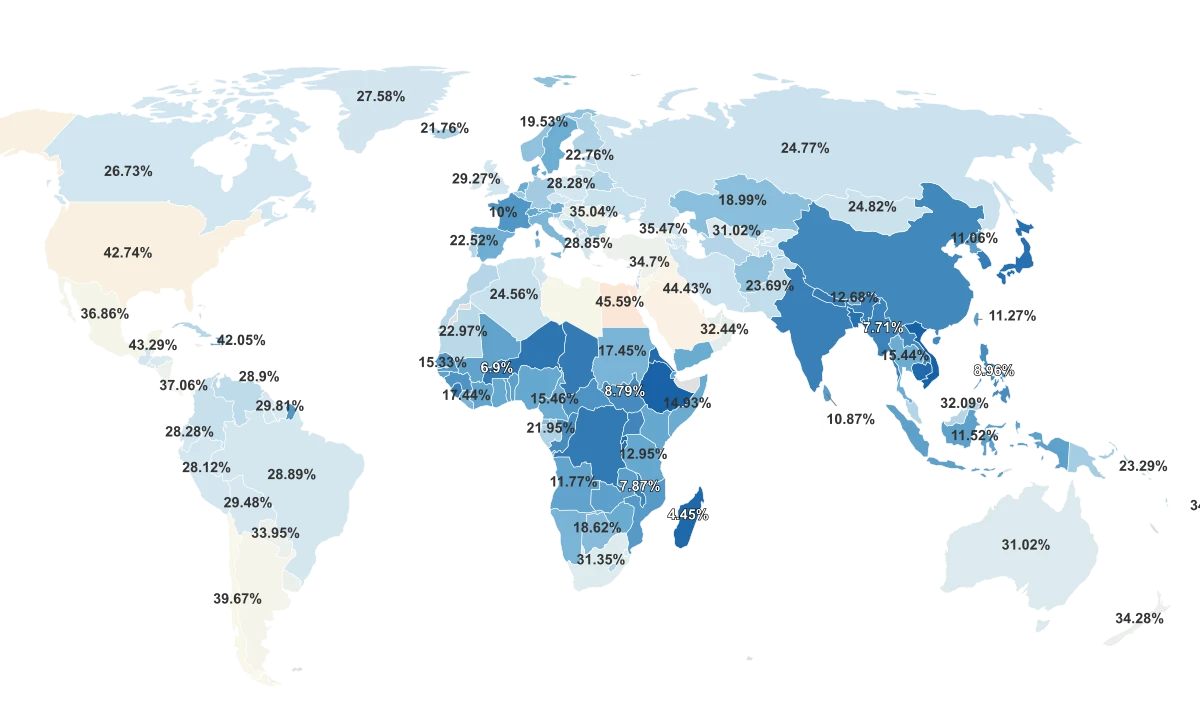
The estimated percentage of individuals experiencing depression or other common mental disorders.