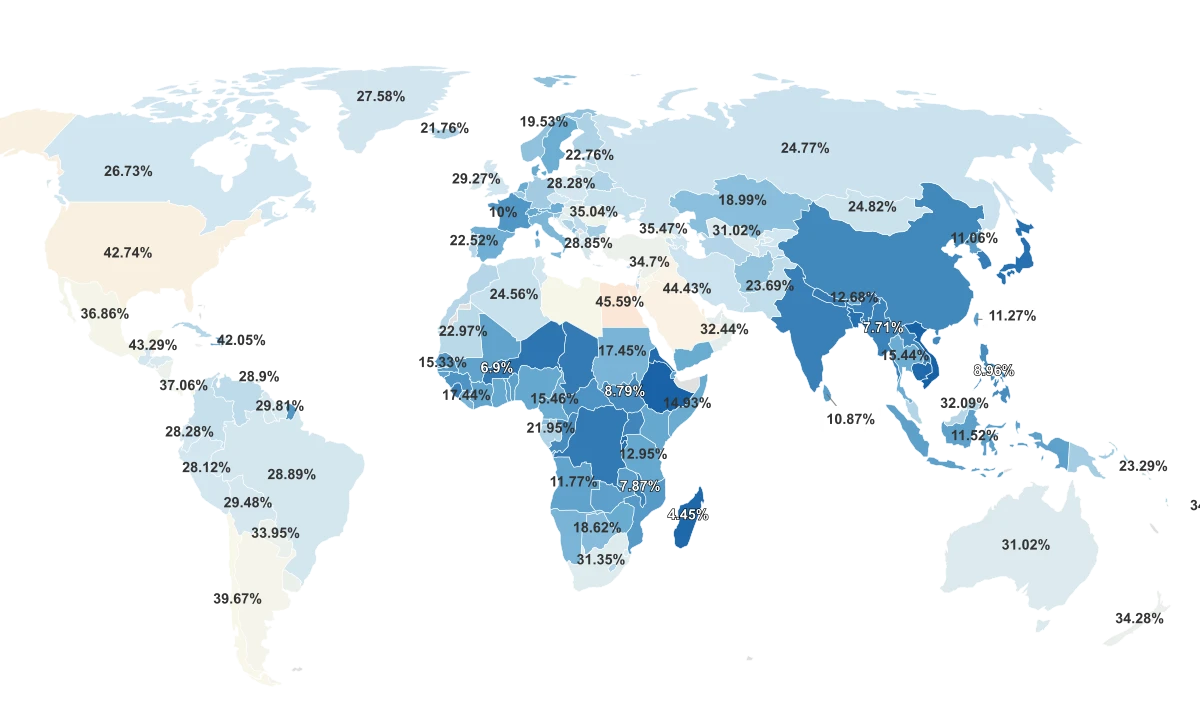
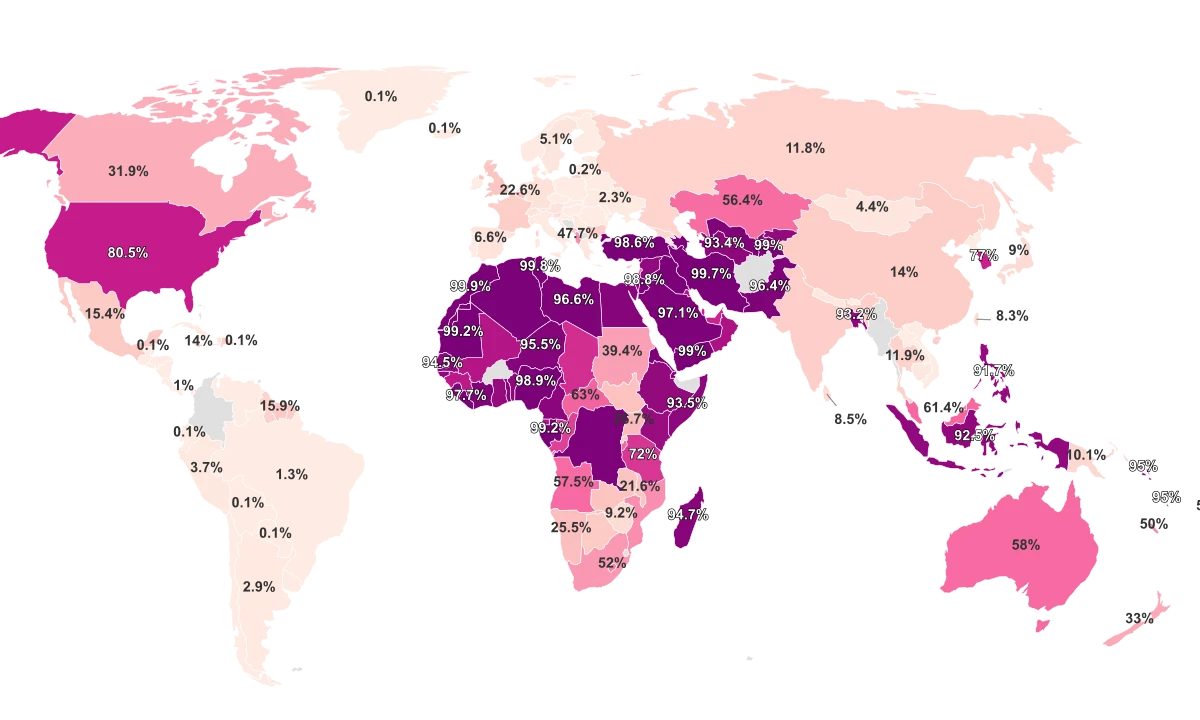
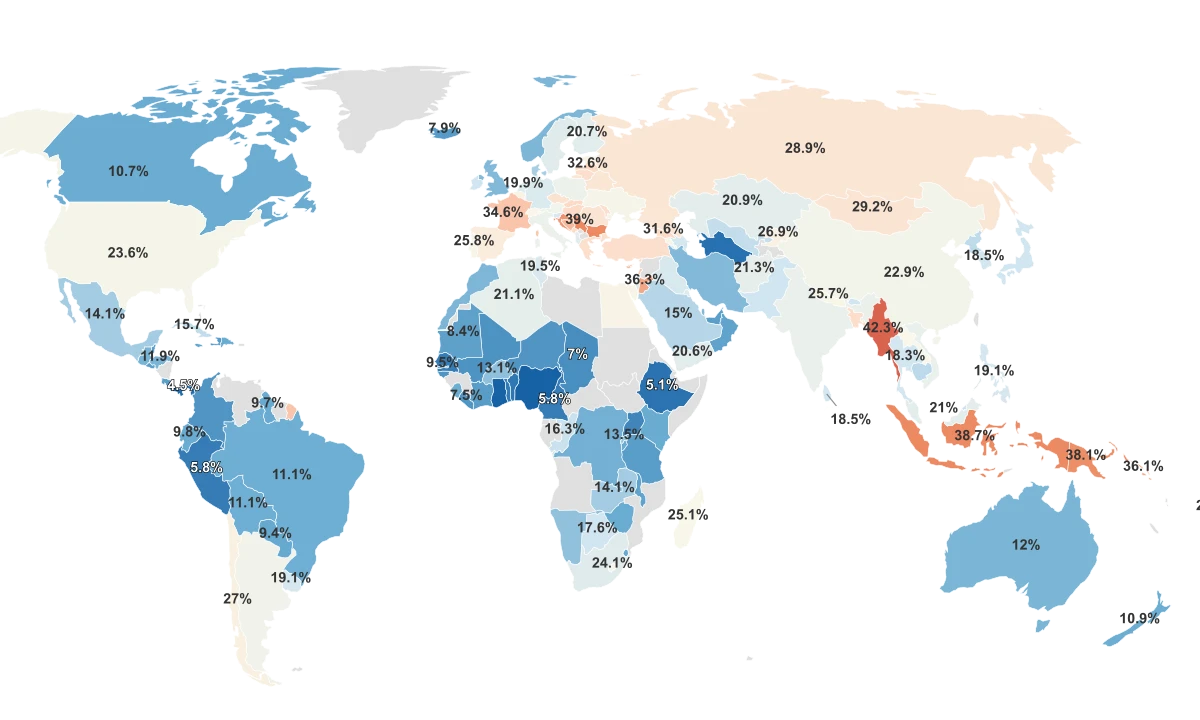
Smoking Rates By Country

1 |  | Nauru | 46.7% |
2 |  | Myanmar | 42.3% |
3 |  | Serbia | 39% |
4 |  | Bulgaria | 38.8% |
5 |  | Indonesia | 38.7% |
6 |  | Papua New Guinea | 38.1% |
7 |  | Croatia | 37.6% |
8 |  | Timor Leste | 37.2% |
9 |  | Kiribati | 36.8% |
10 |  | Andorra | 36.4% |
11 |  | Jordan | 36.3% |
12 |  | Solomon Islands | 36.1% |
13 |  | Bosnia and Herzegovina | 35.2% |
14 |  | Cyprus | 35% |
15 |  | France | 34.6% |
16 |  | Lebanon | 34.1% |
17 |  | Slovakia | 32.8% |
18 |  | Latvia | 32.6% |
19 |  | Tuvalu | 32.2% |
20 |  | Georgia | 31.6% |
21 |  | Montenegro | 31.5% |
21 |  | Hungary | 31.5% |
23 |  | Tonga | 31.1% |
24 |  | Bangladesh | 30.8% |
25 |  | Greece | 30.6% |
26 |  | Moldova | 30.5% |
27 |  | Marshall Islands | 30.4% |
28 |  | Turkey | 30.2% |
28 |  | Lithuania | 30.2% |
30 |  | Czech Republic | 29.4% |
31 |  | Romania | 29.3% |
32 |  | Mongolia | 29.2% |
33 |  | Russia | 28.9% |
33 |  | Belarus | 28.9% |
35 |  | Spain | 27.8% |
36 |  | Fiji | 27% |
36 |  | Chile | 27% |
38 |  | Kyrgyzstan | 26.9% |
39 |  | Estonia | 26.4% |
40 |  | Belgium | 26.3% |
41 |  | Egypt | 25.8% |
41 |  | Cook Islands | 25.8% |
41 |  | Portugal | 25.8% |
44 |  | Nepal | 25.7% |
45 |  | Switzerland | 25.3% |
46 |  | Laos | 25.1% |
46 |  | Madagascar | 25.1% |
48 |  | Maldives | 24.9% |
49 |  | Lesotho | 24.1% |
49 |  | Armenia | 24.1% |
51 |  | Malta | 23.9% |
52 |  | Ukraine | 23.6% |
52 |  | United States | 23.6% |
54 |  | China | 22.9% |
55 |  | Argentina | 22.6% |
56 |  | Austria | 22.5% |
57 |  | Luxembourg | 22.3% |
58 |  | Italy | 22.1% |
58 |  | Poland | 22.1% |
60 |  | India | 21.8% |
61 |  | Vietnam | 21.7% |
62 |  | Afghanistan | 21.3% |
63 |  | Algeria | 21.1% |
64 |  | Malaysia | 21% |
65 |  | Kazakhstan | 20.9% |
66 |  | Samoa | 20.8% |
67 |  | Albania | 20.7% |
67 |  | Finland | 20.7% |
69 |  | Yemen | 20.6% |
70 |  | Sweden | 20.5% |
70 |  | South Africa | 20.5% |
70 |  | Mauritius | 20.5% |
73 |  | Kuwait | 20% |
74 |  | Netherlands | 19.9% |
75 |  | Seychelles | 19.7% |
75 |  | Germany | 19.7% |
77 |  | Slovenia | 19.5% |
77 |  | Tunisia | 19.5% |
79 |  | Iraq | 19.2% |
79 |  | Israel | 19.2% |
81 |  | Uruguay | 19.1% |
81 |  | Philippines | 19.1% |
83 |  | Azerbaijan | 18.7% |
84 |  | South Korea | 18.5% |
84 |  | Sri Lanka | 18.5% |
86 |  | Thailand | 18.3% |
87 |  | Japan | 17.8% |
87 |  | Ireland | 17.8% |
89 |  | Bhutan | 17.6% |
89 |  | Botswana | 17.6% |
91 |  | Pakistan | 17.2% |
92 |  | Palau | 16.6% |
93 |  | Brunei | 16.4% |
94 |  | Republic of the Congo | 16.3% |
95 |  | Singapore | 16.2% |
96 |  | Uzbekistan | 15.8% |
97 |  | Cuba | 15.7% |
98 |  | Comoros | 15.5% |
99 |  | North Korea | 15.4% |
100 |  | Cambodia | 15.3% |
101 |  | Saudi Arabia | 15% |
102 |  | Denmark | 14.4% |
103 |  | Bahrain | 14.3% |
104 |  | Zambia | 14.1% |
104 |  | Mexico | 14.1% |
106 |  | Rwanda | 13.5% |
107 |  | Saint Lucia | 13.3% |
108 |  | Namibia | 13.2% |
109 |  | Burkina Faso | 13.1% |
110 |  | United Kingdom | 12.5% |
110 |  | Iran | 12.5% |
110 |  | Qatar | 12.5% |
113 |  | Morocco | 12.2% |
113 |  | Norway | 12.2% |
115 |  | Australia | 12% |
116 |  | Honduras | 11.9% |
117 |  | Guatemala | 11.8% |
118 |  | DR Congo | 11.5% |
119 |  | Bahamas | 11.3% |
120 |  | Brazil | 11.1% |
120 |  | Bolivia | 11.1% |
122 |  | Sierra Leone | 11% |
123 |  | New Zealand | 10.9% |
124 |  | Canada | 10.7% |
125 |  | Zimbabwe | 10.4% |
126 |  | Cape Verde | 10.2% |
127 |  | Burundi | 10.1% |
128 |  | Kenya | 9.9% |
129 |  | Ecuador | 9.8% |
129 |  | Dominican Republic | 9.8% |
131 |  | Guyana | 9.7% |
132 |  | Gambia | 9.5% |
133 |  | Paraguay | 9.4% |
134 |  | Eswatini | 9.3% |
135 |  | Jamaica | 9% |
136 |  | Oman | 8.6% |
136 |  | Malawi | 8.6% |
138 |  | Mauritania | 8.4% |
139 |  | El Salvador | 8.3% |
139 |  | Belize | 8.3% |
141 |  | United Arab Emirates | 8.2% |
142 |  | Tanzania | 8.1% |
142 |  | Costa Rica | 8.1% |
142 |  | Sao Tome and Principe | 8.1% |
145 |  | Ivory Coast | 8% |
146 |  | Iceland | 7.9% |
147 |  | Haiti | 7.8% |
148 |  | Liberia | 7.5% |
148 |  | Colombia | 7.5% |
148 |  | Niger | 7.5% |
151 |  | Mali | 7.3% |
151 |  | Guinea Bissau | 7.3% |
153 |  | Chad | 7% |
154 |  | Barbados | 6.7% |
155 |  | Uganda | 6.4% |
156 |  | Senegal | 5.8% |
156 |  | Cameroon | 5.8% |
156 |  | Peru | 5.8% |
159 |  | Togo | 5.7% |
160 |  | Benin | 5.5% |
161 |  | Ethiopia | 5.1% |
162 |  | Turkmenistan | 4.9% |
163 |  | Panama | 4.5% |
164 |  | Ghana | 3.1% |
165 |  | Nigeria | 2.8% |
Last updated June 25, 2026
Key Takeaways
- Nauru reports the highest current tobacco use of any country, at 46.7% of adults, followed by Myanmar at 42.3%.
- Nigeria reports the lowest, at 2.8%, with Ghana just above it at 3.1%.
- The gap from top to bottom is nearly 44 percentage points, but the typical country sits near 19%.
- The heaviest-use band is a Balkan and Eastern-European cluster, where strong tobacco laws often go under-enforced.
All Metrics
What the WHO Actually Counts as Tobacco Use
The numbers here describe current tobacco use among adults, and the spread is wide. Nauru leads at 46.7%, where nearly half of adults use tobacco, while Nigeria sits at the bottom at 2.8%. A higher rate simply means more people use tobacco, not that a country is worse run or its people less disciplined.
These figures come from the World Health Organization's Global Health Observatory, reflecting 2025 estimates for people aged 15 and older. The rates are age-standardized so countries with older or younger populations can be compared fairly. One detail matters before reading further: the WHO measure counts use of any tobacco product, smoked and smokeless, not cigarettes alone.
Across the 165 countries with data, the typical national rate sits near 19%, and most of the world clusters not far from there. The real story is geographic. The countries that break far above the pack are not the wealthy, long-lived nations many readers might expect, and the lowest rates belong to West and Sub-Saharan Africa.
Why the Smoking Map Doesn't Match the Cancer Map
Most people assume a map of tobacco use would line up neatly with a map of cancer and early death. Across countries, it does not. The places that report the heaviest tobacco use are not, as a rule, the places with the highest recorded cancer rates or the shortest lives.
In this data, tobacco use and life expectancy actually move together slightly, a weak and faintly positive relationship that explains only about 6% of the variation between countries. Tobacco use and recorded cancer rates track a little more closely, but still weakly, explaining roughly 11%. The single strongest relationship in the whole dataset links cancer rates to life expectancy, and it does not involve tobacco at all.
Heavy Tobacco Use Does Not Map to Shorter Lives Across Countries
Plotted against life expectancy, national tobacco-use rates form a weak, slightly positive cloud, the opposite of what most readers expect to see.
The reason is development, not biology. Wealthier, longer-lived countries detect and record far more cancer, and they have had the time and the institutions to drive their own tobacco rates down. Poorer countries with thinner health systems record less and often use less tobacco to begin with. The World Bank notes a further twist: surveys in high-income countries often ask only about cigarettes and miss other tobacco forms, nudging their reported rates down.
This is a textbook case of an ecological trap, where a pattern visible between countries says nothing about any individual. Nigeria records the lowest tobacco use in the dataset, at 2.8%, and also one of the lowest life expectancies, at 54.6 years. That pairing is a product of poverty and weak health infrastructure, not proof that avoiding tobacco shortens a life. At the level of a single person, the harms of tobacco are not in dispute. The country-level numbers simply cannot see them, because development moves both maps at once.
The Balkan and Eastern-European Cluster
If the heaviest tobacco use does not follow wealth, what does it follow? The clearest answer in the data is a single region. Just below the two highest-ranked countries sits a dense band of Balkan and Eastern-European nations, the part of the world most consistently identified with weaker tobacco-control enforcement.
Serbia reports 39.0% and Bulgaria 38.8%, with Croatia, Bosnia and Herzegovina, and several of their neighbours close behind. Western Europe appears too: France sits at 34.6%, higher than many would guess. A peer-reviewed analysis of the 2023 WHO tobacco report found that many Balkan countries have adopted strong tobacco-control policies on paper, but that in many cases there is a lack of implementation.
That distinction is the heart of it. The laws often exist, the enforcement and the real-world tax levels lag behind. The World Health Organization's Framework Convention on Tobacco Control and its MPOWER package of measures, raising taxes, banning advertising, protecting indoor air, only push prevalence down where countries enforce them. The WHO's 2025 trends report found Europe is now the highest-prevalence region in the world.
The two countries above the European cluster sit there for different reasons. Myanmar, at 42.3%, ranks so high partly because the WHO measure captures smokeless and oral tobacco and traditional forms like cheroot and betel quid, which run deep in local custom and would be invisible to a cigarette-only count. Nauru, the small Pacific nation at the very top, sits nearly 28 percentage points above the typical national rate, a distance no other country approaches, though its specific drivers are not established in the data here.
What a Low Number Does and Doesn't Mean
The bottom of this table is mostly West and Sub-Saharan Africa, and those low numbers deserve a careful read. Nigeria and Ghana, at 2.8% and 3.1%, anchor the ranking, and the distribution overall is fairly even, with no small club of countries carrying a global problem and no dramatic tail at either end.
Two things are true of these low figures at once. They reflect genuinely lower historical tobacco use across much of the region. They also carry wide uncertainty, because the WHO model estimates prevalence for survey-sparse countries by borrowing from similar neighbours, so a number like Ghana's is an informed estimate, not a precise count. This is the one place to hold the data loosely.
The label on this ranking is also narrower than the data behind it. The indicator measures current use of any tobacco product, smoked and smokeless, among adults 15 and older, modeled and age-standardized rather than directly counted. It is not a tally of daily cigarette smokers, which is why countries with strong chewing or oral-tobacco traditions can rank higher than their cigarette habits alone would suggest.
A low rate today is not immunity. The WHO's 2025 report found Africa has the lowest tobacco prevalence of any region, yet the absolute number of users keeps rising as populations grow and the market is targeted. The ranking captures where tobacco use stands now. It does not promise where it is heading.
Sources & Notes
% of the population that smokes tobacco.
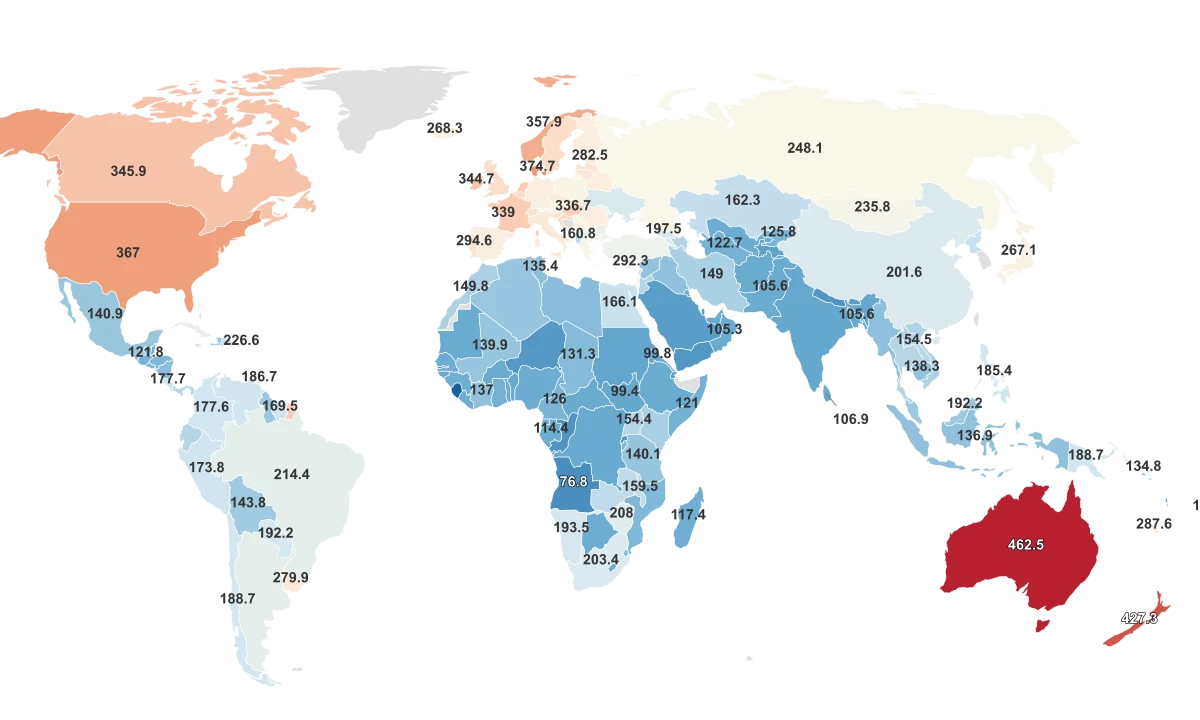
Annual number of new cancer cases per 100,000 people.
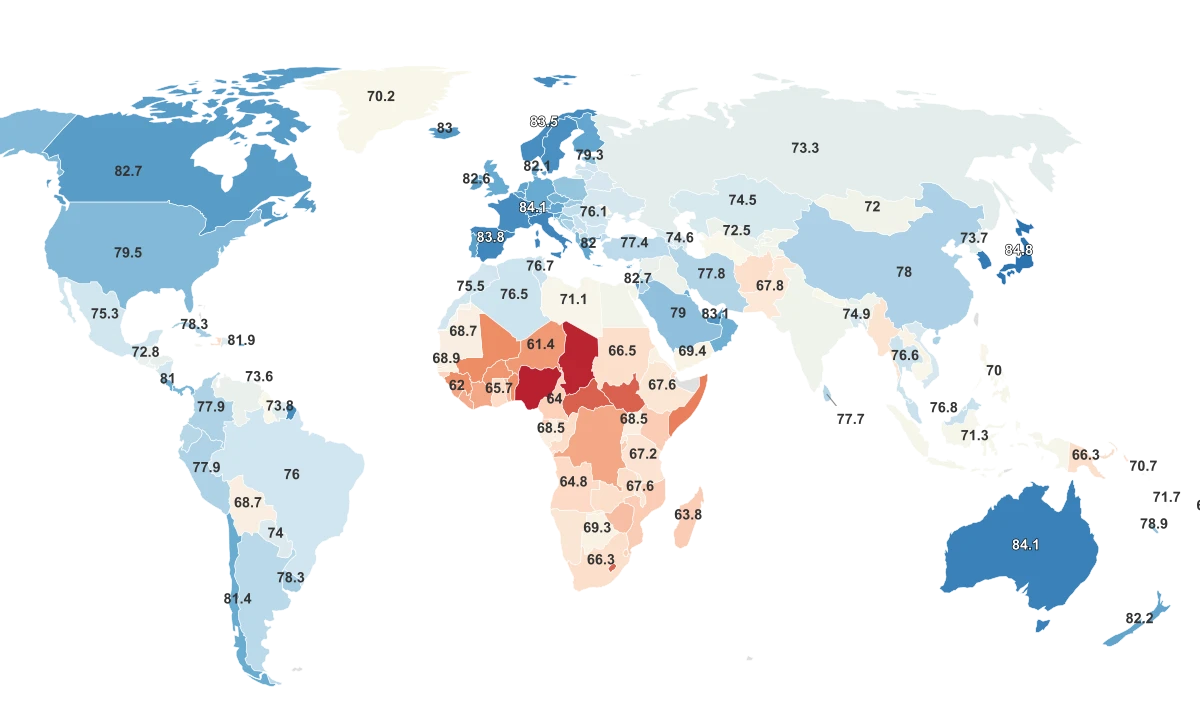
Average number of years a newborn is expected to live.