Breast Size By Country

 | Afghanistan | B | |
 | Albania | C | |
 | Algeria | B | |
 | Andorra | C | |
 | Angola | B | |
 | Argentina | C | |
 | Armenia | C | |
 | Australia | C | |
 | Austria | D | |
 | Azerbaijan | B | |
 | Bahamas | A | |
 | Bahrain | A | |
 | Bangladesh | A | |
 | Barbados | A | |
 | Belarus | A | |
 | Belgium | C | |
 | Belize | B | |
 | Benin | A | |
 | Bhutan | A | |
 | Bolivia | A | |
 | Bosnia and Herzegovina | D | |
 | Botswana | B | |
 | Brazil | C | |
 | Brunei | A | |
 | Bulgaria | D | |
 | Burkina Faso | A | |
 | Burundi | A | |
 | Cambodia | A | |
 | Cameroon | B | |
 | Canada | C | |
 | Cape Verde | B | |
 | Central African Republic | A | |
 | Chad | B | |
 | Chile | C | |
 | China | A | |
 | Colombia | D | |
 | Comoros | A | |
 | Costa Rica | C | |
 | Croatia | D | |
 | Cuba | B | |
 | Cyprus | B | |
 | Czech Republic | D | |
 | Denmark | D | |
 | Djibouti | A | |
 | Dominica | A | |
 | Dominican Republic | B | |
 | DR Congo | A | |
 | Ecuador | B | |
 | Egypt | B | |
 | El Salvador | A | |
 | Equatorial Guinea | A | |
 | Eritrea | A | |
 | Estonia | C | |
 | Eswatini | A | |
 | Ethiopia | B | |
 | Fiji | A | |
 | Finland | DD | |
 | France | C | |
 | Gabon | B | |
 | Gambia | A | |
 | Georgia | C | |
 | Germany | D | |
 | Ghana | B | |
 | Greece | C | |
 | Grenada | B | |
 | Guadeloupe | B | |
 | Guatemala | A | |
 | Guinea | A | |
 | Guinea Bissau | A | |
 | Guyana | A | |
 | Haiti | A | |
 | Honduras | A | |
 | Hong Kong | A | |
 | Hungary | D | |
 | Iceland | D | |
 | India | B | |
 | Indonesia | A | |
 | Iran | B | |
 | Iraq | B | |
 | Ireland | B | |
 | Israel | A | |
 | Italy | C | |
 | Ivory Coast | A | |
 | Jamaica | B | |
 | Japan | A | |
 | Jordan | A | |
 | Kazakhstan | B | |
 | Kenya | A | |
 | Kuwait | A | |
 | Kyrgyzstan | A | |
 | Laos | A | |
 | Latvia | A | |
 | Lebanon | A | |
 | Lesotho | A | |
 | Liberia | A | |
 | Libya | B | |
 | Liechtenstein | D | |
 | Lithuania | C | |
 | Luxembourg | D | |
 | Madagascar | B | |
 | Malawi | A | |
 | Malaysia | A | |
 | Maldives | B | |
 | Mali | A | |
 | Malta | A | |
 | Mauritania | A | |
 | Mauritius | A | |
 | Mexico | B | |
 | Moldova | B | |
 | Mongolia | A | |
 | Montenegro | C | |
 | Morocco | B | |
 | Mozambique | B | |
 | Myanmar | A | |
 | Nepal | A | |
 | Netherlands | D | |
 | New Zealand | B | |
 | Nicaragua | A | |
 | Niger | A | |
 | Nigeria | A | |
 | North Korea | A | |
 | North Macedonia | B | |
 | Norway | DD | |
 | Oman | A | |
 | Pakistan | B | |
 | Panama | B | |
 | Papua New Guinea | A | |
 | Paraguay | B | |
 | Peru | A | |
 | Philippines | A | |
 | Poland | C | |
 | Portugal | B | |
 | Puerto Rico | B | |
 | Qatar | A | |
 | Republic of the Congo | A | |
 | Romania | C | |
 | Russia | DD | |
 | Rwanda | A | |
 | Saint Lucia | A | |
 | Saint Vincent and the Grenadines | A | |
 | Samoa | A | |
 | Sao Tome and Principe | A | |
 | Saudi Arabia | B | |
 | Senegal | A | |
 | Serbia | C | |
 | Sierra Leone | A | |
 | Singapore | A | |
 | Slovakia | C | |
 | Slovenia | C | |
 | Solomon Islands | B | |
 | Somalia | B | |
 | South Africa | B | |
 | South Korea | A | |
 | Spain | B | |
 | Sri Lanka | A | |
 | Sudan | A | |
 | Suriname | A | |
 | Sweden | DD | |
 | Switzerland | D | |
 | Syria | B | |
 | Taiwan | A | |
 | Tajikistan | B | |
 | Tanzania | A | |
 | Thailand | A | |
 | Timor Leste | A | |
 | Togo | A | |
 | Trinidad and Tobago | A | |
 | Tunisia | A | |
 | Turkey | B | |
 | Turkmenistan | B | |
 | Uganda | A | |
 | Ukraine | C | |
 | United Arab Emirates | B | |
 | United Kingdom | C | |
 | United States | DD | |
 | Uruguay | C | |
 | Uzbekistan | B | |
 | Vanuatu | B | |
 | Venezuela | D | |
 | Vietnam | A | |
 | Western Sahara | A | |
 | Yemen | A | |
 | Zambia | A | |
 | Zimbabwe | A |
Last updated June 24, 2026
Key Takeaways
- Most countries report a small average cup: of 184 with data, 88 average an A and 51 a B.
- Only five report an average DD: Sweden, Russia, Norway, the United States, and Finland.
- The heaviest-BMI countries report small cups, not large ones: Samoa, with one of the world's highest female BMI figures, averages an A.
- The figure tracks how bras are sized and sold more than body size, and its publishers call it not scientifically reliable.
All Metrics
Most of the World Reports an A or a B Cup
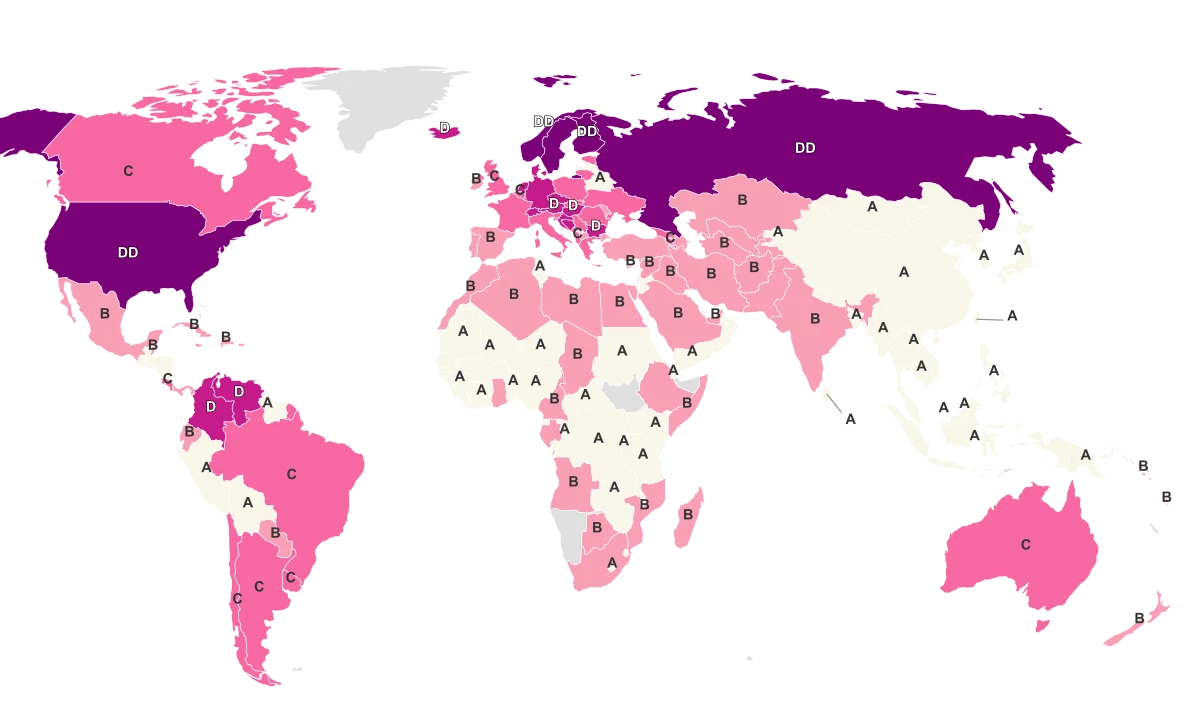
Across 184 countries, the typical national average is a small cup. Sweden reports the largest average at a DD, while dozens of countries across Asia and Africa report an A at the other end. The map is best read as a record of reported bra sizes, not a measure of who is bigger or better.
The figures come from AverageHeight, a consumer body-metrics aggregator, which compiles a single average US-standard cup letter for each country from retail and survey data for 2024. There is no clinical measurement behind a letter, and no band size attached to it, so the scale is coarse by design. It runs from A at the low end to DD at the high end.
Small cups dominate the list. An A is the single most common national average, reported for 88 countries, and a B covers another 51. That leaves the larger letters rare: 25 countries average a C, 15 a D, and just five reach a DD. A reader scanning for a world of wide variation instead finds most of the planet packed into two letters at the bottom of the scale.
The Heaviest Countries Are Not the Largest-Cup Countries
The intuitive rule is that heavier populations should report larger cups. At the level of an individual woman, that rule has real support: a study of more than 24,000 women found body mass index to be the strongest single predictor of breast size, with a roughly 24 centimetre difference in bust line between the heaviest and leanest groups. The country averages tell a different story.
The five DD countries are not heavy nations. Sweden, Norway, and Finland all sit near or below the global average female BMI of about 26.4, the level the World Health Organization calls overweight. The clearest break comes in the Pacific. Samoa carries one of the highest female BMI figures in the world at 32.4, well into the obese range, yet it reports an average A cup.
So the cup ranking and the body-weight ranking do not line up at the top. They partly converge at the bottom: across East Asia, low BMI and small cups appear together, with Japan, South Korea, and China all reporting both some of the lowest BMI figures and an A cup. Breast size is also highly heritable and varies by ancestry, which is why a national letter blends genetics, age, and reproduction with body weight rather than reading straight off the scale.
How a National Cup Letter Gets Made
Before drawing firm conclusions, it helps to know where a national cup letter comes from. These are not clinical measurements. The common method is to infer an average from bra sales and self-reported surveys, then convert across competing national sizing systems into a single US-standard letter. Much of the data circulating online traces back through a thin chain to a single 2010 compilation, whose own publishers write that the exercise cannot and should not be treated as scientifically reliable.
Three problems make cross-country comparison especially loose. A labelled cup is not universal, because the same letter means different volumes on different band sizes and across brands, a gap researchers call vanity sizing. Many women wear the wrong size, which skews any estimate built from sales. And cosmetic augmentation rates differ by country, which lifts reported averages in places like Venezuela and Colombia, both of which report a D.
None of this makes the pattern meaningless. The same Western countries surface near the top across most retail and survey compilations, and the small-cup clustering in East Asia is consistent. The honest reading is narrow: this is a map of reported sizing behaviour, shaped by measurement habits and self-report, and it should not be mistaken for a precise ranking of bodies.
Sources & Notes
The average bra cup size among adult females in standard US sizes.
Health metric that calculates body weight relative to height among women.