Non-Extradition States

 | Alabama | Standard | |
 | Alaska | Standard | |
 | Arizona | Standard | |
 | Arkansas | Standard | |
 | California | Standard | |
 | Colorado | Shield Law | |
 | Connecticut | Modified | |
 | Delaware | Modified | |
 | Florida | Standard | |
 | Georgia | Standard | |
 | Hawaii | Shield Law | |
 | Idaho | Standard | |
 | Illinois | Shield Law | |
 | Indiana | Standard | |
 | Iowa | Standard | |
 | Kansas | Standard | |
 | Kentucky | Standard | |
 | Louisiana | Standard | |
 | Maine | Shield Law | |
 | Maryland | Shield Law | |
 | Massachusetts | Modified + Shield Law | |
 | Michigan | Standard | |
 | Minnesota | Shield Law | |
 | Mississippi | Not Adopted | |
 | Missouri | Standard | |
 | Montana | Standard | |
 | Nebraska | Standard | |
 | Nevada | Shield Law | |
 | New Hampshire | Standard | |
 | New Jersey | Shield Law | |
 | New Mexico | Shield Law | |
 | New York | Modified + Shield Law | |
 | North Carolina | Standard | |
 | North Dakota | Not Adopted | |
 | Ohio | Standard | |
 | Oklahoma | Standard | |
 | Oregon | Standard | |
 | Pennsylvania | Standard | |
 | Rhode Island | Modified | |
 | South Carolina | Not Adopted | |
 | South Dakota | Standard | |
 | Tennessee | Standard | |
 | Texas | Standard | |
 | Utah | Standard | |
 | Vermont | Shield Law | |
 | Virginia | Standard | |
 | Washington | Shield Law | |
 | West Virginia | Standard | |
 | Wisconsin | Standard | |
 | Wyoming | Standard |
Last updated April 1, 2026
Every State Extradites. The Differences Are in the Details.
The idea that certain U.S. states will not extradite you is one of the most persistent legal myths on the internet. It is also wrong. The Constitution's Extradition Clause (Article IV, Section 2) requires every state to surrender a person charged with a crime in another state when the demanding state's governor makes a formal request. Federal law (18 U.S.C. § 3182) reinforces that obligation, and the Supreme Court's 1987 ruling in Puerto Rico v. Branstad confirmed that federal courts can compel a governor to comply.
What does vary is the procedural framework each state uses to carry out that obligation. In 1936, the Uniform Law Commission drafted the Uniform Criminal Extradition Act to standardize the process: how warrants are issued, how hearings work, how long a state can hold someone before the demanding state picks them up. Most states adopted it. But not all of them adopted it the same way, and some never adopted it at all.
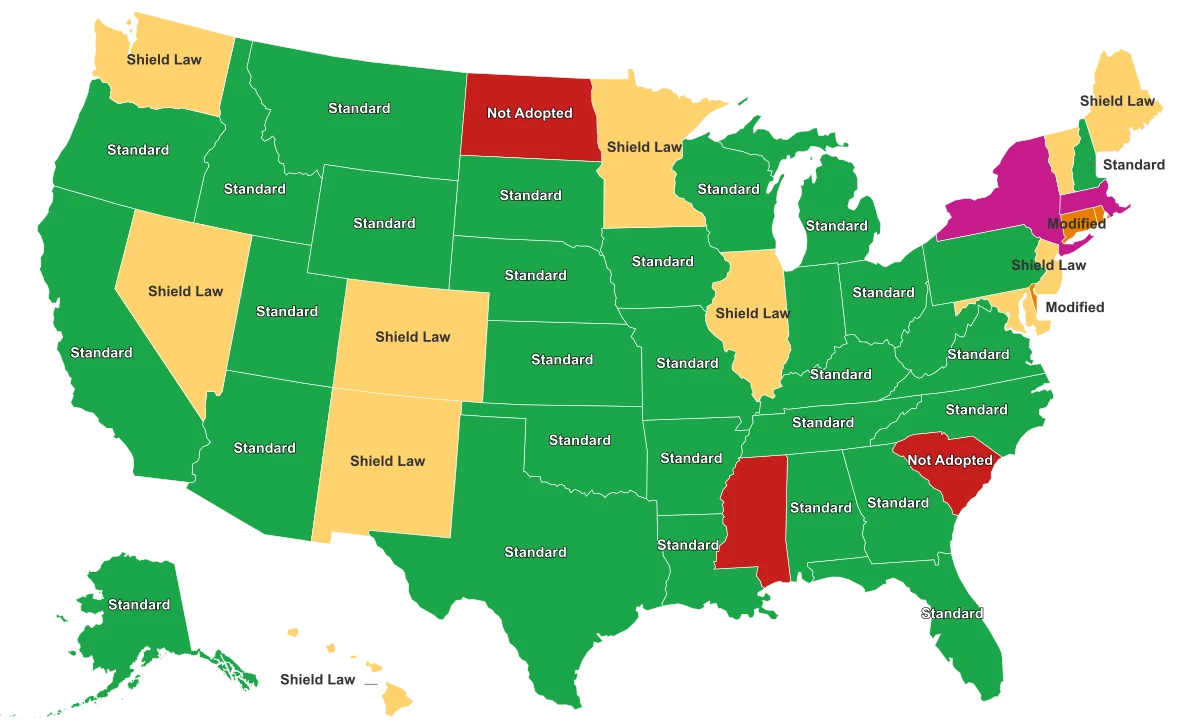
The current landscape breaks into five categories. 31 states use the standard UCEA as written. 11 states have added shield law protections that block extradition for specific reproductive health offenses. Three states adopted a modified version that limits extradition for people who were never physically present in the demanding state. Two states combine both the modified provision and shield law protections. And three states have never adopted the UCEA at all, relying instead on their own statutory procedures.
None of these categories create a "non-extradition state." They create different procedural paths, some with targeted carve-outs for specific offenses, but all of them operate under the same constitutional mandate.
Why Three States Never Adopted the Uniform Law
Mississippi, South Carolina, and North Dakota are the only states that have not adopted the Uniform Criminal Extradition Act in any form. That fact has fueled the persistent myth that these states will not extradite people. The reality is less dramatic.
All three states have their own extradition statutes that fulfill their constitutional obligations under Article IV. A fugitive arrested in Mississippi is still subject to the same basic process: the demanding state's governor files a formal request, the asylum state's governor reviews it, and if the legal requirements are met, a warrant is issued. The difference is procedural, not substantive. Mississippi's code spells out its own timeline for hearings and its own rules for how warrants are served rather than using the standardized UCEA language.
The practical effect of operating outside the UCEA is modest. Without the uniform framework, some procedural steps may take longer because law enforcement and courts are working from state-specific statutes rather than the model law that most prosecutors and defense attorneys across the country already know. But a longer timeline is not immunity. A person wanted for a felony in Texas who is found in South Carolina will still be arrested and held for extradition, just under South Carolina's own rules instead of the UCEA's.
Where real gaps can appear is with low-level offenses. Every state, including UCEA adopters, exercises practical discretion about whether the cost of transporting a suspect across state lines is worth it for a misdemeanor. That decision has nothing to do with whether a state adopted the UCEA. It is a budget question, and it applies everywhere.
The Shield Law States That Rewrote Extradition After Dobbs
The most significant shift in the extradition landscape did not come from the three states that skipped the UCEA. It came from the states that adopted it and then carved out a new exception on top of it.
After the Supreme Court's 2022 decision in Dobbs v. Jackson Women's Health Organization overturned Roe v. Wade, states that had protected abortion access faced a new legal problem. Providers in those states could potentially be charged by prosecutors in states where the same procedures were now criminal, and those states could theoretically seek extradition. In response, 13 states enacted what are broadly called reproductive health shield laws.
These shield laws do several things at once. They prohibit the governor from honoring extradition requests for offenses related to reproductive health care that is legal in the shield state. They block state and local law enforcement from cooperating with out-of-state investigations, subpoenas, or search warrants targeting that care. And they protect healthcare providers from losing their medical licenses over procedures that are lawful where they practice.
Hawaii, New Jersey, Washington, Nevada, Maine, Maryland, Minnesota, Colorado, Vermont, Illinois, and New Mexico have all enacted these protections. New York and Massachusetts go further, combining shield law protections with a modified UCEA provision that limits extradition of non-fugitives more broadly.
The scope of these laws varies. Some states, including Colorado, Washington, and Massachusetts, have expanded protections to cover telehealth prescriptions and the mailing of medication abortion to patients in restrictive states, according to the Center for Reproductive Rights. Others protect only care delivered when the patient is physically present within the shield state. The result is not a uniform block. It is a second patchwork layered on top of the first.
These shield laws have created genuine interstate conflict. The constitutional question of whether a state can exercise criminal jurisdiction over conduct that occurred entirely within another state's borders, and whether the asylum state must cooperate, remains largely untested in federal court. Legal scholars cite the Dormant Commerce Clause, the right to interstate travel, and the Privileges and Immunities Clause as potential limits on cross-border prosecution, but no definitive ruling has resolved the tension.
What "Modified" Actually Means for Non-Fugitives
The shield law debate gets the headlines, but a quieter distinction in the UCEA may matter just as much for certain types of cases. It comes down to one section of the uniform law: Section 6, which governs what happens when someone is charged with a crime in a state they were never physically in.
Under the Constitution's Extradition Clause, the obligation applies to people who have "fled from justice," meaning they were present in the state when the crime occurred and then left. But the standard UCEA extends beyond that. Its Section 6 gives governors the discretion to extradite people even when they were never in the demanding state at the time of the alleged offense.
That provision was originally designed for cases where someone committed a crime remotely: hiring someone to commit fraud, mailing threatening letters, or orchestrating a scheme from across state lines. In 1936, those scenarios were rare. Today, with telehealth, digital commerce, and interstate supply chains, they are not.
Delaware, Rhode Island, and Connecticut adopted a modified version of the UCEA that adds a dual-criminality requirement to Section 6. In plain terms, their governors will not extradite a non-fugitive unless the alleged conduct is also a crime under their own state's laws. If a provider in Connecticut is charged by a prosecutor in another state for an act that is perfectly legal under Connecticut law, the modified UCEA gives the governor a statutory basis to refuse the request.
New York and Massachusetts have this same modified provision along with their shield laws, creating a double layer of protection: the modified Section 6 covers non-fugitives broadly, and the shield law specifically targets reproductive health offenses.
The 31 states with the standard UCEA have no such limitation. Their governors retain the discretion to extradite non-fugitives even for conduct that would be legal in their own state. Whether they would exercise that discretion is a political question, not a legal one. The standard UCEA gives them the authority. The modified version takes it away.
Sources & Notes
Classifies each state by how it has adopted the Uniform Criminal Extradition Act: whether it enacted the standard provision authorizing extradition of non-fugitives, a modified version limiting extradition to offenses also recognized in the asylum state, a shield law protecting against extradition for reproductive health offenses, a combination of modified and shield law protections, or has not adopted the UCEA at all.