Most Developed Countries In Africa

1— |  | Seychelles | 0.848+0.046 (+5.7%) |
2— |  | Mauritius | 0.806+0.01 (+1.3%) |
3▲1 |  | Algeria | 0.763+0.018 (+2.4%) |
4▲2 |  | Egypt | 0.754+0.026 (+3.6%) |
5— |  | Tunisia | 0.746+0.014 (+1.9%) |
6▲1 |  | South Africa | 0.741+0.024 (+3.3%) |
7▲3 |  | Gabon | 0.733+0.04 (+5.8%) |
8— |  | Botswana | 0.731+0.023 (+3.2%) |
9▼6 |  | Libya | 0.721-0.025 (-3.4%) |
10▼1 |  | Morocco | 0.71+0.012 (+1.7%) |
11▲3 |  | Eswatini | 0.695+0.085 (+14%) |
12— |  | Equatorial Guinea | 0.674+0.024 (+3.7%) |
13▼2 |  | Cape Verde | 0.668+0.007 (+1.1%) |
14— |  | Namibia | 0.665+0.055 (+9.0%) |
15▲3 |  | Republic of the Congo | 0.649+0.056 (+9.4%) |
16▼3 |  | Sao Tome and Principe | 0.637+0.024 (+3.9%) |
17— |  | Kenya | 0.628+0.027 (+4.5%) |
17▼1 |  | Ghana | 0.628+0.026 (+4.3%) |
19— |  | Angola | 0.616+0.025 (+4.2%) |
20▲1 |  | Comoros | 0.603+0.017 (+2.9%) |
21▲2 |  | Zimbabwe | 0.598+0.048 (+8.7%) |
22— |  | Zambia | 0.595+0.026 (+4.6%) |
23▼3 |  | Cameroon | 0.588+0.001 (+0.2%) |
24▼1 |  | Uganda | 0.582+0.032 (+5.8%) |
24▲5 |  | Ivory Coast | 0.582+0.048 (+9.0%) |
26▼1 |  | Rwanda | 0.578+0.03 (+5.5%) |
27— |  | Togo | 0.571+0.024 (+4.4%) |
28— |  | Mauritania | 0.563+0.023 (+4.3%) |
29▼4 |  | Nigeria | 0.56+0.012 (+2.2%) |
30— |  | Tanzania | 0.555+0.023 (+4.3%) |
31— |  | Lesotho | 0.55+0.029 (+5.6%) |
32— |  | Senegal | 0.53+0.013 (+2.5%) |
33▲4 |  | Gambia | 0.524+0.029 (+5.9%) |
34▲9 |  | DR Congo | 0.522+0.041 (+8.5%) |
35— |  | Malawi | 0.517+0.009 (+1.8%) |
36— |  | Benin | 0.515+0.011 (+2.2%) |
37▲5 |  | Guinea Bissau | 0.514+0.031 (+6.4%) |
38▼4 |  | Djibouti | 0.513-0.002 (-0.4%) |
39▼6 |  | Sudan | 0.511-0.005 (-1.0%) |
40— |  | Liberia | 0.51+0.023 (+4.7%) |
41▼3 |  | Eritrea | 0.503+0.01 (+2.0%) |
42▲2 |  | Guinea | 0.5+0.029 (+6.2%) |
43▼4 |  | Ethiopia | 0.497+0.005 (+1.0%) |
44▲1 |  | Mozambique | 0.493+0.032 (+6.9%) |
45▼5 |  | Madagascar | 0.487 |
46— |  | Sierra Leone | 0.467+0.009 (+2.0%) |
47— |  | Burkina Faso | 0.459+0.021 (+4.8%) |
48— |  | Burundi | 0.439+0.019 (+4.5%) |
49— |  | Mali | 0.419+0.009 (+2.2%) |
49▲1 |  | Niger | 0.419+0.025 (+6.3%) |
51▼1 |  | Chad | 0.416+0.022 (+5.6%) |
52— |  | Central African Republic | 0.414+0.027 (+7.0%) |
53▲1 |  | Somalia | 0.404+0.024 (+6.3%) |
54▼1 |  | South Sudan | 0.388+0.007 (+1.8%) |
Last updated June 25, 2026
Key Takeaways
- Seychelles leads African development with a Human Development Index of 0.848, one of only two African countries above the 0.800 "very high human development" threshold.
- South Sudan sits last at 0.388, the lowest score in Africa and in the world, a little over half of the continental leader's value.
- The continent's typical country lands near 0.57, and the spread is wide: the top score is more than twice the bottom one.
- The clearest pattern is not about money. Several oil-rich countries rank well below where their incomes alone would place them, while the bottom of the table is occupied almost entirely by states in prolonged conflict.
All Metrics
What the Human Development Index Actually Measures in Africa
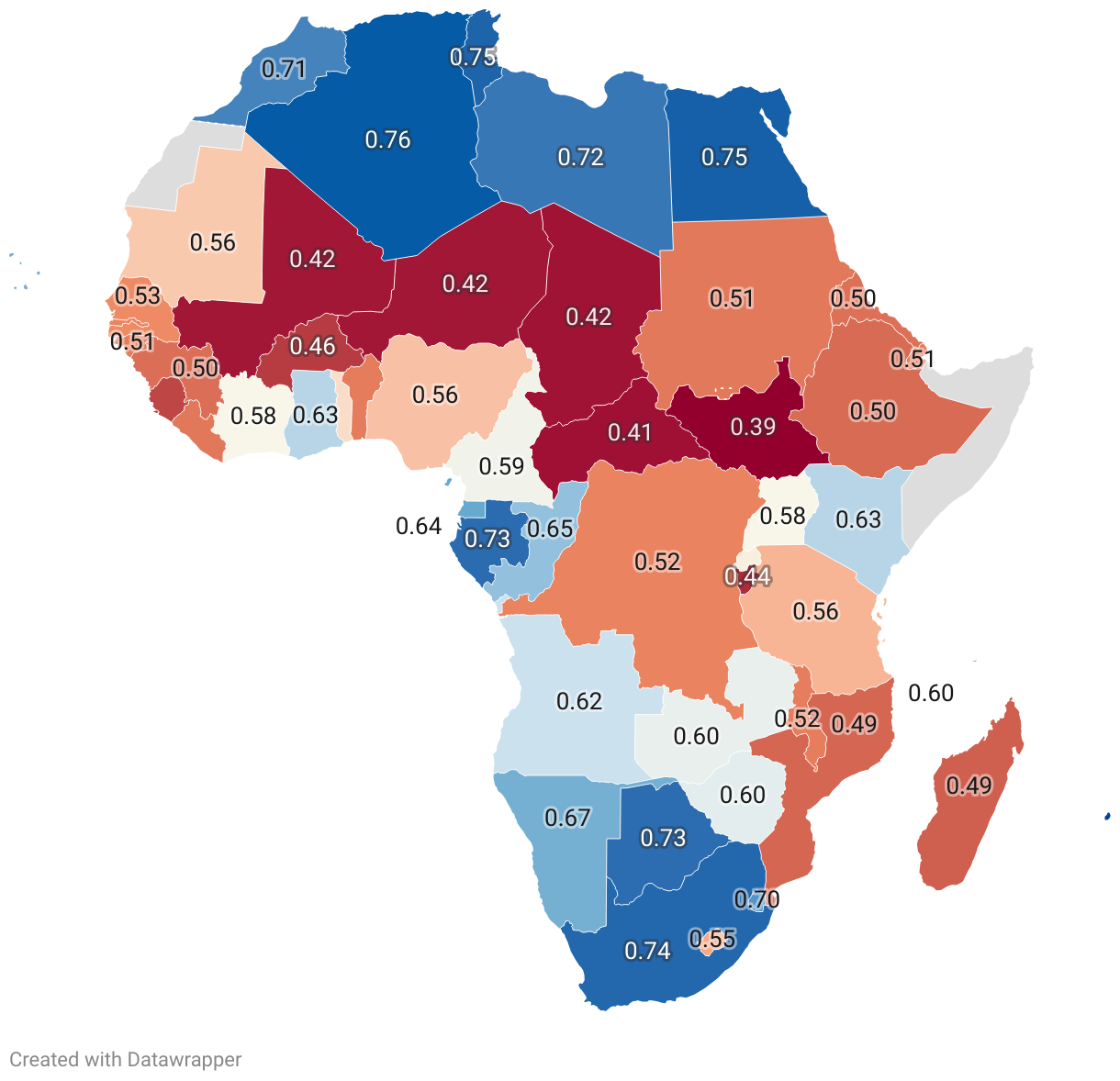
The most developed country in Africa is Seychelles, which posts a Human Development Index of 0.848, while South Sudan anchors the bottom at 0.388. The figures come from the United Nations Development Programme's 2025 Human Development Report, using 2023 data, and they cover 54 African countries. A higher score means more development, so the top of this table reads as the countries where people live longer, learn more, and earn more, taken together.
That "taken together" is the part most rankings skip. The HDI is not an income league table; it is a geometric mean of three pieces: a long and healthy life measured by life expectancy, knowledge measured by years of schooling, and a decent standard of living measured by income per person. A country has to do well on all three to score well, which is why the order here does not simply follow the richest economies.
The typical African country sits near 0.57 on the index, and most of the continent clusters in the band between roughly 0.50 and 0.65. A short group at the top pulls well clear of that crowd, and a smaller group at the bottom falls far below it, which is where the real story of this ranking lives.
| Rank | Country | Human Development Index (2023) |
|---|---|---|
| 1 | Seychelles | 0.848 |
| 2 | Mauritius | 0.806 |
| 3 | Algeria | 0.763 |
| 4 | Egypt | 0.754 |
| 5 | Tunisia | 0.746 |
| 6 | South Africa | 0.741 |
| ... | ... | ... |
| 49 | Chad | 0.416 |
| 50 | Central African Republic | 0.414 |
| 51 | Somalia | 0.404 |
| 52 | South Sudan | 0.388 |
Two Islands Sit in a Class of Their Own
Africa's development ceiling is set by two small island nations, not by any of its large or wealthy mainland powers. Seychelles at 0.848 and Mauritius at 0.806 are the only African countries to clear 0.800, the line the UNDP uses for its "very high human development" band. Both sit far enough above the field that no third country comes close; the gap from Mauritius down to third place is wider than the gap that separates the next several countries from one another.
What these two share is not natural resources but stability and a service economy. Tourism, financial services, and small, well-governed populations let them push life expectancy, schooling, and income up at the same time, which is exactly what the index rewards. It is a different growth model from the commodity exporters that dominate Africa's raw GDP figures.
Behind the islands sits a recognizable North African tier. Algeria leads the mainland at 0.763, trailed closely by Egypt and Tunisia, with South Africa at 0.741 the highest-ranked country south of the Sahara. These are the economies people often expect to top an Africa development list, yet on a measure that weighs health and education alongside income, they sit a clear step below two islands with a fraction of their population.
Why the Bottom of the Table Is a Map of Conflict
The bottom of this ranking is not random; it is a near-perfect overlay of where war and displacement have been worst. South Sudan is last at 0.388, the lowest figure in Africa and on Earth, followed by Somalia at 0.404 and the Central African Republic at 0.414. Chad and Niger complete the lowest tier, none of them above 0.420.
The mechanism behind these numbers is documented and structural. In South Sudan, brutal conflict since 2013 has driven millions from their homes, with more than two million people forced into neighbouring countries and over 2.3 million refugees and asylum-seekers from the country in the region. When a third of a population is displaced, the schooling and life-expectancy pillars of the index collapse together, and the income pillar with them.
This is the reason the index is read with care rather than as a verdict on a nation's worth. A score near 0.40 reflects a state contending with armed conflict, food insecurity, and recurrent flooding, not a measure of its people. The bottom cluster is best understood as a development emergency, the kind that humanitarian agencies, not rankings, are built to address.
Income Buys a Head Start, Not a Finish
The most useful thing this dataset shows is where money and development come apart. Richer countries do tend to score higher, but income alone does not set the order, because it is only one of the index's three pillars. The clearest evidence sits in the gap between a country's income rank and its development rank.
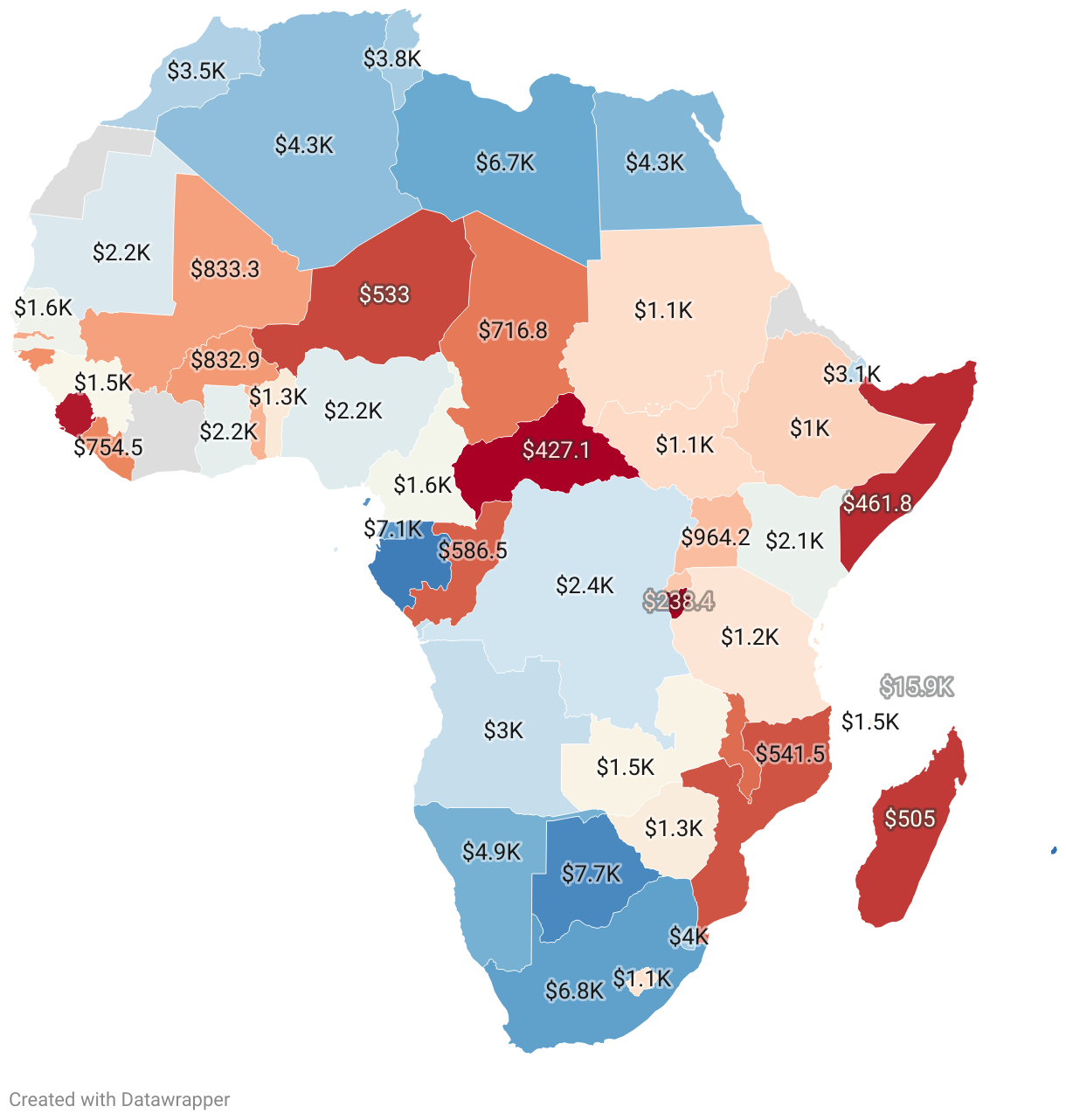
Equatorial Guinea is the sharpest case. Its oil wealth makes it the fifth-highest earner on the continent, at $7,053 in income per person, yet it ranks only twelfth on human development, at 0.674. Gabon tells the same story from third place on income down to seventh on development. The World Bank describes the pattern bluntly for Equatorial Guinea: despite the oil receipts, 24% of the population still lack electricity and 32.4% have no access to piped water, and it frames the country's core challenge as diversifying away from oil and investing in human development.
The mirror image is Rwanda, which earns far less per person yet has climbed steadily up the index on the strength of health and schooling gains rather than resource rents. The lesson the ranking teaches is that income buys a country a head start, but the countries that convert it into longer lives and more years in school are the ones that finish near the top.
A Continent That Has Climbed, Unevenly
Step back three decades and the dominant trend is progress, not stagnation. Across the countries with data running back to 1990, the continent's human development has risen by roughly 37%, a gain built on longer lives and more schooling almost everywhere. Mozambique more than doubled its score over that span, from 0.238 to 0.493. Rwanda rose about 81% in the same period, a climb the UNDP attributes to sustained gains in health and schooling rather than resource wealth.
The climb reshuffled the table as much as it lifted it. Morocco rose eight places in the ranking since 1990 and Uganda six, while the Central African Republic fell 24 places, its early-1990s standing erased by years of instability. The same forces that hold the bottom of the table down today are the ones that moved countries down the ranking over time.
Africa's Development Has Climbed for Three Decades
Human development rose across the continent between 1990 and 2023, but conflict-hit states gained least and a few slipped backward in rank.
The uneven part matters as much as the gain. Progress has been fastest in stable, peacetime economies and slowest, or reversed, in the places caught by conflict, which is the same divide that separates the top of the 2023 table from the bottom. Development on this continent has been less a steady tide than a story of who got the conditions to rise.
Sources & Notes
Measure of overall human development combining life expectancy, education, and income levels.