Largest Countries In The World

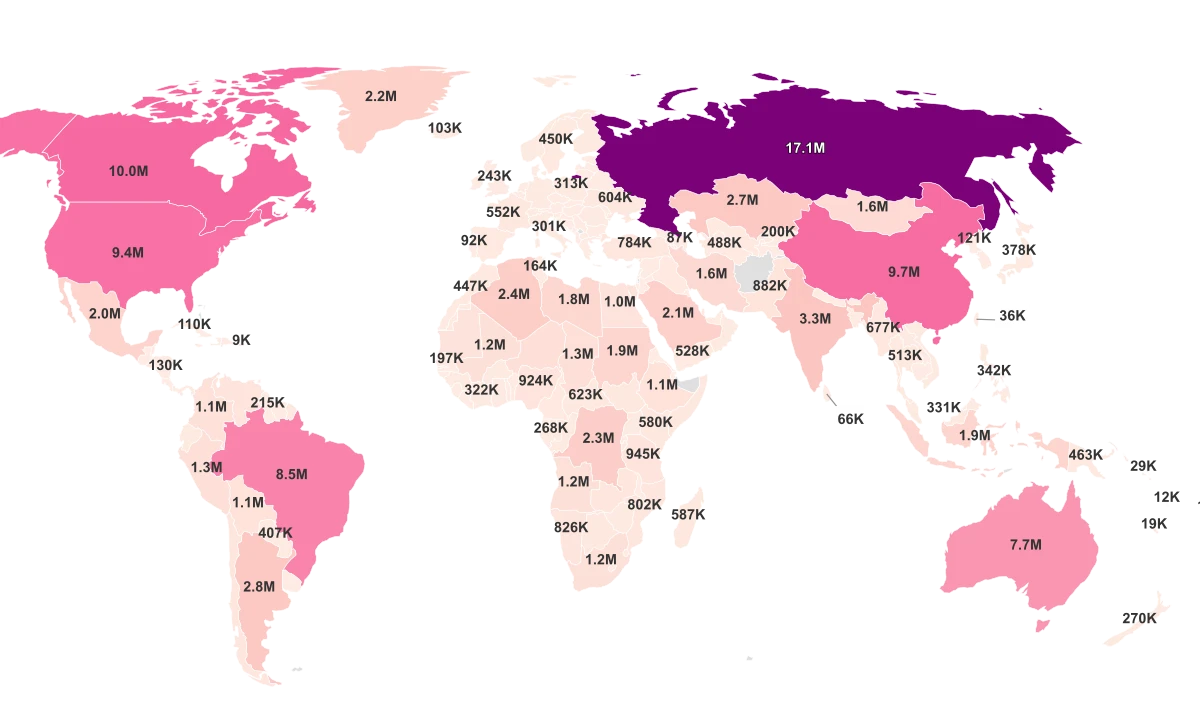
1 |  | Russia | 17,098,242km² |
2 |  | Canada | 9,984,670km² |
3 |  | China | 9,706,961km² |
4 |  | United States | 9,372,610km² |
5 |  | Brazil | 8,515,767km² |
6 |  | Australia | 7,692,024km² |
7 |  | India | 3,287,590km² |
8 |  | Argentina | 2,780,400km² |
9 |  | Kazakhstan | 2,724,900km² |
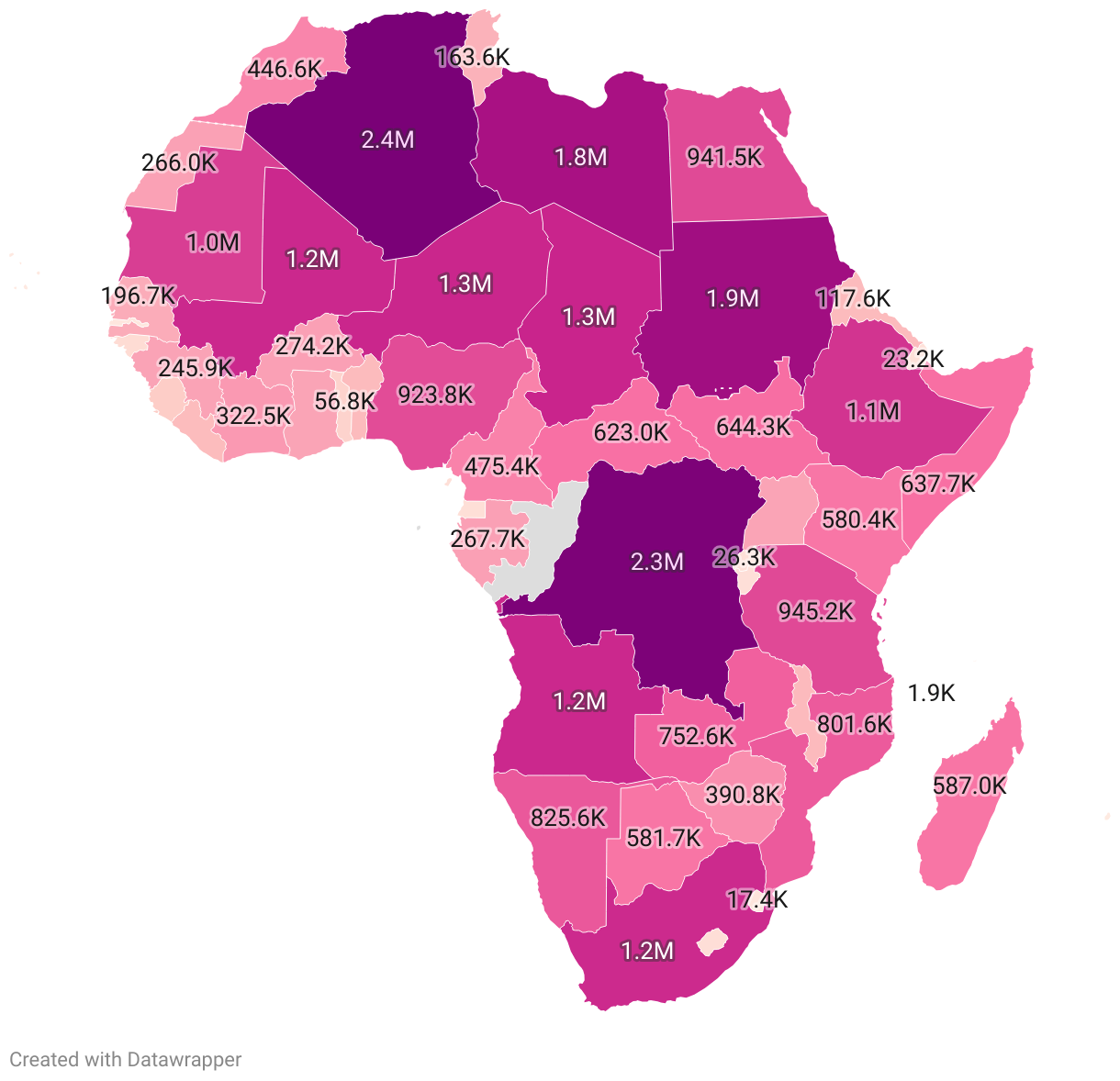
10 |  | Algeria | 2,381,741km² |
11 |  | DR Congo | 2,344,858km² |
12 |  | Greenland | 2,166,086km² |
13 |  | Saudi Arabia | 2,149,690km² |
14 |  | Mexico | 1,964,375km² |
15 |  | Indonesia | 1,904,569km² |
16 |  | Sudan | 1,886,068km² |
17 |  | Libya | 1,759,540km² |
18 |  | Iran | 1,648,195km² |
19 |  | Mongolia | 1,564,110km² |
20 |  | Peru | 1,285,216km² |
21 |  | Chad | 1,284,000km² |
22 |  | Niger | 1,267,000km² |
23 |  | Angola | 1,246,700km² |
24 |  | Mali | 1,240,192km² |
25 |  | South Africa | 1,221,037km² |
26 |  | Colombia | 1,141,748km² |
27 |  | Ethiopia | 1,104,300km² |
28 |  | Bolivia | 1,098,581km² |
29 |  | Mauritania | 1,030,700km² |
30 |  | Egypt | 1,002,450km² |
31 |  | Tanzania | 945,087km² |
32 |  | Nigeria | 923,768km² |
33 |  | Venezuela | 916,445km² |
34 |  | Pakistan | 881,912km² |
35 |  | Namibia | 825,615km² |
36 |  | Mozambique | 801,590km² |
37 |  | Turkey | 783,562km² |
38 |  | Chile | 756,102km² |
39 |  | Zambia | 752,612km² |
40 |  | Myanmar | 676,578km² |
41 |  | Palestine | 652,230km² |
42 |  | Somalia | 637,657km² |
43 |  | Central African Republic | 622,984km² |
44 |  | South Sudan | 619,745km² |
45 |  | Ukraine | 603,500km² |
46 |  | Madagascar | 587,041km² |
47 |  | Botswana | 582,000km² |
48 |  | Kenya | 580,367km² |
49 |  | France | 551,695km² |
50 |  | Yemen | 527,968km² |
51 |  | Thailand | 513,120km² |
52 |  | Spain | 505,992km² |
53 |  | Turkmenistan | 488,100km² |
54 |  | Cameroon | 475,442km² |
55 |  | Papua New Guinea | 462,840km² |
56 |  | Sweden | 450,295km² |
57 |  | Uzbekistan | 447,400km² |
58 |  | Morocco | 446,550km² |
59 |  | Iraq | 438,317km² |
60 |  | Paraguay | 406,752km² |
61 |  | Zimbabwe | 390,757km² |
62 |  | Japan | 377,930km² |
63 |  | Germany | 357,114km² |
64 |  | Philippines | 342,353km² |
65 |  | Republic of the Congo | 342,000km² |
66 |  | Finland | 338,424km² |
67 |  | Vietnam | 331,212km² |
68 |  | Malaysia | 330,803km² |
69 |  | Norway | 323,802km² |
70 |  | Ivory Coast | 322,463km² |
71 |  | Poland | 312,679km² |
72 |  | Oman | 309,500km² |
73 |  | Italy | 301,336km² |
74 |  | Ecuador | 276,841km² |
75 |  | Burkina Faso | 272,967km² |
76 |  | New Zealand | 270,467km² |
77 |  | Gabon | 267,668km² |
78 |  | Western Sahara | 266,000km² |
79 |  | Guinea | 245,857km² |
80 |  | United Kingdom | 242,900km² |
81 |  | Uganda | 241,550km² |
82 |  | Ghana | 238,533km² |
83 |  | Romania | 238,391km² |
84 |  | Laos | 236,800km² |
85 |  | Guyana | 214,969km² |
86 |  | Belarus | 207,600km² |
87 |  | Kyrgyzstan | 199,951km² |
88 |  | Senegal | 196,722km² |
89 |  | Syria | 185,180km² |
90 |  | Cambodia | 181,035km² |
91 |  | Uruguay | 181,034km² |
92 |  | Suriname | 163,820km² |
93 |  | Tunisia | 163,610km² |
94 |  | Bangladesh | 147,570km² |
95 |  | Nepal | 147,181km² |
96 |  | Tajikistan | 143,100km² |
97 |  | Greece | 131,990km² |
98 |  | Nicaragua | 130,373km² |
99 |  | North Korea | 120,538km² |
100 |  | Malawi | 118,484km² |
101 |  | Eritrea | 117,600km² |
102 |  | Benin | 112,622km² |
103 |  | Honduras | 112,492km² |
104 |  | Liberia | 111,369km² |
105 |  | Bulgaria | 110,879km² |
106 |  | Cuba | 109,884km² |
107 |  | Guatemala | 108,889km² |
108 |  | Iceland | 103,000km² |
109 |  | South Korea | 100,210km² |
110 |  | Hungary | 93,028km² |
111 |  | Portugal | 92,090km² |
112 |  | Jordan | 89,342km² |
113 |  | Serbia | 88,361km² |
114 |  | Azerbaijan | 86,600km² |
115 |  | Austria | 83,871km² |
116 |  | United Arab Emirates | 83,600km² |
117 |  | French Guiana | 83,534km² |
118 |  | Czech Republic | 78,865km² |
119 |  | Panama | 75,417km² |
120 |  | Sierra Leone | 71,740km² |
121 |  | Ireland | 70,273km² |
122 |  | Georgia | 69,700km² |
123 |  | Sri Lanka | 65,610km² |
124 |  | Lithuania | 65,300km² |
125 |  | Latvia | 64,559km² |
126 |  | Togo | 56,785km² |
127 |  | Croatia | 56,594km² |
128 |  | Bosnia and Herzegovina | 51,209km² |
129 |  | Costa Rica | 51,100km² |
130 |  | Slovakia | 49,037km² |
131 |  | Dominican Republic | 48,671km² |
132 |  | Estonia | 45,227km² |
133 |  | Denmark | 43,094km² |
134 |  | Netherlands | 41,850km² |
135 |  | Switzerland | 41,284km² |
136 |  | Bhutan | 38,394km² |
137 |  | Taiwan | 36,193km² |
138 |  | Guinea Bissau | 36,125km² |
139 |  | Moldova | 33,846km² |
140 |  | Belgium | 30,528km² |
141 |  | Lesotho | 30,355km² |
142 |  | Armenia | 29,743km² |
143 |  | Solomon Islands | 28,896km² |
144 |  | Albania | 28,748km² |
145 |  | Equatorial Guinea | 28,051km² |
146 |  | Burundi | 27,834km² |
147 |  | Haiti | 27,750km² |
148 |  | Rwanda | 26,338km² |
149 |  | North Macedonia | 25,713km² |
150 |  | Djibouti | 23,200km² |
151 |  | Belize | 22,966km² |
152 |  | El Salvador | 21,041km² |
153 |  | Israel | 20,770km² |
154 |  | Slovenia | 20,273km² |
155 |  | New Caledonia | 18,575km² |
156 |  | Fiji | 18,272km² |
157 |  | Kuwait | 17,818km² |
158 |  | Eswatini | 17,364km² |
159 |  | Timor Leste | 14,874km² |
160 |  | Bahamas | 13,943km² |
161 |  | Montenegro | 13,812km² |
162 |  | Vanuatu | 12,189km² |
163 |  | Qatar | 11,586km² |
164 |  | Jamaica | 10,991km² |
165 |  | Gambia | 10,689km² |
166 |  | Lebanon | 10,452km² |
167 |  | Cyprus | 9,251km² |
168 |  | Puerto Rico | 8,870km² |
169 |  | Brunei | 5,765km² |
170 |  | Trinidad and Tobago | 5,130km² |
171 |  | French Polynesia | 4,167km² |
172 |  | Cape Verde | 4,033km² |
173 |  | Samoa | 2,842km² |
174 |  | Luxembourg | 2,586km² |
175 |  | Mauritius | 2,040km² |
176 |  | Comoros | 1,862km² |
177 |  | Guadeloupe | 1,628km² |
178 |  | Martinique | 1,128km² |
179 |  | Sao Tome and Principe | 964km² |
180 |  | Turks and Caicos Islands | 948km² |
181 |  | Kiribati | 811km² |
182 |  | Bahrain | 765km² |
183 |  | Dominica | 751km² |
184 |  | Tonga | 747km² |
185 |  | Singapore | 710km² |
186 |  | Micronesia | 702km² |
187 |  | Saint Lucia | 616km² |
188 |  | Isle Of Man | 572km² |
189 |  | Guam | 549km² |
190 |  | Andorra | 468km² |
191 |  | Northern Mariana Islands | 464km² |
192 |  | Palau | 459km² |
193 |  | Seychelles | 452km² |
194 |  | Curacao | 444km² |
195 |  | Antigua and Barbuda | 442km² |
196 |  | Barbados | 430km² |
197 |  | Saint Vincent and the Grenadines | 389km² |
198 |  | Mayotte | 374km² |
199 |  | Grenada | 344km² |
200 |  | Malta | 316km² |
201 |  | Maldives | 300km² |
202 |  | Cayman Islands | 264km² |
203 |  | Saint Kitts and Nevis | 261km² |
204 |  | Saint Pierre and Miquelon | 242km² |
205 |  | Cook Islands | 236km² |
206 |  | American Samoa | 199km² |
207 |  | Marshall Islands | 181km² |
208 |  | Aruba | 180km² |
209 |  | Liechtenstein | 160km² |
210 |  | British Virgin Islands | 151km² |
211 |  | Montserrat | 102km² |
212 |  | Anguilla | 91km² |
213 |  | San Marino | 61km² |
214 |  | Bermuda | 54km² |
215 |  | Saint Martin | 53km² |
216 |  | Sint Maarten | 34km² |
217 |  | Tuvalu | 26km² |
218 |  | Saint Barthelemy | 21km² |
218 |  | Nauru | 21km² |
220 |  | Gibraltar | 6km² |
221 |  | Monaco | 2km² |
222 |  | Vatican City | 0.44km² |
Last updated June 25, 2026
Key Takeaways
- Russia is the world's largest country at about 17.1 million square kilometres, roughly an eighth of all the land held by the world's countries combined.
- The smallest is Vatican City at 0.44 square kilometres, small enough to fit inside Russia almost 40 million times over.
- The five biggest countries, Russia, Canada, China, the United States and Brazil, together hold 40.4% of all country area, while the typical country covers only about 88,850 square kilometres.
- Whether Canada or China ranks second flips depending on one choice: count a country's inland lakes and rivers, or only its dry land.
All Metrics
| Region ↕ | Total Area 2023↕ | Land Area 2021↕ | Population 2025↕ | Density↕ |
|---|---|---|---|---|
| Russia | 17.1M Km² | |||
| Canada | 10.0M Km² | |||
| China | 9.7M Km² | |||
| United States | 9.4M Km² | |||
| Brazil | 8.5M Km² | |||
| Australia | 7.7M Km² | |||
| India | 3.3M Km² | |||
| Argentina | 2.8M Km² | |||
| Kazakhstan | 2.7M Km² | |||
| Algeria | 2.4M Km² | |||
| DR Congo | 2.3M Km² | |||
| Greenland | 2.2M Km² | |||
| Saudi Arabia | 2.1M Km² | |||
| Mexico | 2.0M Km² | |||
| Indonesia | 1.9M Km² | |||
| Sudan | 1.9M Km² | |||
| Libya | 1.8M Km² | |||
| Iran | 1.6M Km² | |||
| Mongolia | 1.6M Km² | |||
| Peru | 1.3M Km² | |||
| Chad | 1.3M Km² | |||
| Niger | 1.3M Km² | |||
| Angola | 1.2M Km² | |||
| Mali | 1.2M Km² | |||
| South Africa | 1.2M Km² | |||
| Colombia | 1.1M Km² | |||
| Ethiopia | 1.1M Km² | |||
| Bolivia | 1.1M Km² | |||
| Mauritania | 1.0M Km² | |||
| Egypt | 1.0M Km² | |||
| Tanzania | 945.1K Km² | |||
| Nigeria | 923.8K Km² | |||
| Venezuela | 916.4K Km² | |||
| Pakistan | 881.9K Km² | |||
| Namibia | 825.6K Km² | |||
| Mozambique | 801.6K Km² | |||
| Turkey | 783.6K Km² | |||
| Chile | 756.1K Km² | |||
| Zambia | 752.6K Km² | |||
| Myanmar | 676.6K Km² | |||
| Palestine | 0.687 | |||
| Somalia | 637.7K Km² | |||
| Central African Republic | 623.0K Km² | |||
| South Sudan | 619.7K Km² | |||
| Ukraine | 603.5K Km² | |||
| Madagascar | 587.0K Km² | |||
| Botswana | 582.0K Km² | |||
| Kenya | 580.4K Km² | |||
| France | 551.7K Km² | |||
| Yemen | 528.0K Km² | |||
| Thailand | 513.1K Km² | |||
| Spain | 506.0K Km² | |||
| Turkmenistan | 488.1K Km² | |||
| Cameroon | 475.4K Km² | |||
| Papua New Guinea | 462.8K Km² | |||
| Sweden | 450.3K Km² | |||
| Uzbekistan | 447.4K Km² | |||
| Morocco | 446.6K Km² | |||
| Iraq | 438.3K Km² | |||
| Paraguay | 406.8K Km² | |||
| Zimbabwe | 390.8K Km² | |||
| Japan | 377.9K Km² | |||
| Germany | 357.1K Km² | |||
| Philippines | 342.4K Km² | |||
| Republic of the Congo | 342.0K Km² | |||
| Finland | 338.4K Km² | |||
| Vietnam | 331.2K Km² | |||
| Malaysia | 330.8K Km² | |||
| Norway | 323.8K Km² | |||
| Ivory Coast | 322.5K Km² | |||
| Poland | 312.7K Km² | |||
| Oman | 309.5K Km² | |||
| Italy | 301.3K Km² | |||
| Ecuador | 276.8K Km² | |||
| Burkina Faso | 273.0K Km² | |||
| New Zealand | 270.5K Km² | |||
| Gabon | 267.7K Km² | |||
| Western Sahara | 266.0K Km² | |||
| Guinea | 245.9K Km² | |||
| United Kingdom | 242.9K Km² | |||
| Uganda | 241.6K Km² | |||
| Ghana | 238.5K Km² | |||
| Romania | 238.4K Km² | |||
| Laos | 236.8K Km² | |||
| Guyana | 215.0K Km² | |||
| Belarus | 207.6K Km² | |||
| Kyrgyzstan | 200.0K Km² | |||
| Senegal | 196.7K Km² | |||
| Syria | 185.2K Km² | |||
| Cambodia | 181.0K Km² | |||
| Uruguay | 181.0K Km² | |||
| Suriname | 163.8K Km² | |||
| Tunisia | 163.6K Km² | |||
| Bangladesh | 147.6K Km² | |||
| Nepal | 147.2K Km² | |||
| Tajikistan | 143.1K Km² | |||
| Greece | 132.0K Km² | |||
| Nicaragua | 130.4K Km² | |||
| North Korea | 120.5K Km² | |||
| Malawi | 118.5K Km² | |||
| Eritrea | 117.6K Km² | |||
| Benin | 112.6K Km² | |||
| Honduras | 112.5K Km² | |||
| Liberia | 111.4K Km² | |||
| Bulgaria | 110.9K Km² | |||
| Cuba | 109.9K Km² | |||
| Guatemala | 108.9K Km² | |||
| Iceland | 103.0K Km² | |||
| South Korea | 100.2K Km² | |||
| Hungary | 93.0K Km² | |||
| Portugal | 92.1K Km² | |||
| Jordan | 89.3K Km² | |||
| Serbia | 88.4K Km² | |||
| Azerbaijan | 86.6K Km² | |||
| Austria | 83.9K Km² | |||
| United Arab Emirates | 83.6K Km² | |||
| French Guiana | 83.5K Km² | |||
| Czech Republic | 78.9K Km² | |||
| Panama | 75.4K Km² | |||
| Sierra Leone | 71.7K Km² | |||
| Ireland | 70.3K Km² | |||
| Georgia | 69.7K Km² | |||
| Sri Lanka | 65.6K Km² | |||
| Lithuania | 65.3K Km² | |||
| Latvia | 64.6K Km² | |||
| Togo | 56.8K Km² | |||
| Croatia | 56.6K Km² | |||
| Bosnia and Herzegovina | 51.2K Km² | |||
| Costa Rica | 51.1K Km² | |||
| Slovakia | 49.0K Km² | |||
| Dominican Republic | 48.7K Km² | |||
| Estonia | 45.2K Km² | |||
| Denmark | 43.1K Km² | |||
| Netherlands | 41.9K Km² | |||
| Switzerland | 41.3K Km² | |||
| Bhutan | 38.4K Km² | |||
| Taiwan | 36.2K Km² | |||
| Guinea Bissau | 36.1K Km² | |||
| Moldova | 33.8K Km² | |||
| Belgium | 30.5K Km² | |||
| Lesotho | 30.4K Km² | |||
| Armenia | 29.7K Km² | |||
| Solomon Islands | 28.9K Km² | |||
| Albania | 28.7K Km² | |||
| Equatorial Guinea | 28.1K Km² | |||
| Burundi | 27.8K Km² | |||
| Haiti | 27.8K Km² | |||
| Rwanda | 26.3K Km² | |||
| North Macedonia | 25.7K Km² | |||
| Djibouti | 23.2K Km² | |||
| Belize | 23.0K Km² | |||
| El Salvador | 21.0K Km² | |||
| Israel | 20.8K Km² | |||
| Slovenia | 20.3K Km² | |||
| New Caledonia | 18.6K Km² | |||
| Fiji | 18.3K Km² | |||
| Kuwait | 17.8K Km² | |||
| Eswatini | 17.4K Km² | |||
| Timor Leste | 14.9K Km² | |||
| Bahamas | 13.9K Km² | |||
| Montenegro | 13.8K Km² | |||
| Vanuatu | 12.2K Km² | |||
| Qatar | 11.6K Km² | |||
| Jamaica | 11.0K Km² | |||
| Gambia | 10.7K Km² | |||
| Lebanon | 10.5K Km² | |||
| Cyprus | 9.3K Km² | |||
| Puerto Rico | 8.9K Km² | |||
| Brunei | 5.8K Km² | |||
| Trinidad and Tobago | 5.1K Km² | |||
| French Polynesia | 4.2K Km² | |||
| Cape Verde | 4.0K Km² | |||
| Samoa | 2.8K Km² | |||
| Luxembourg | 2.6K Km² | |||
| Mauritius | 2.0K Km² | |||
| Comoros | 1.9K Km² | |||
| Guadeloupe | 1.6K Km² | |||
| Martinique | 1.1K Km² | |||
| Sao Tome and Principe | 1.0K Km² | |||
| Turks and Caicos Islands | 948 Km² | |||
| Kiribati | 811 Km² | |||
| Bahrain | 765 Km² | |||
| Dominica | 751 Km² | |||
| Tonga | 747 Km² | |||
| Singapore | 710 Km² | |||
| Micronesia | 702 Km² | |||
| Saint Lucia | 616 Km² | |||
| Isle Of Man | 572 Km² | |||
| Guam | 549 Km² | |||
| Andorra | 468 Km² | |||
| Northern Mariana Islands | 464 Km² | |||
| Palau | 459 Km² | |||
| Seychelles | 452 Km² | |||
| Curacao | 444 Km² | |||
| Antigua and Barbuda | 442 Km² | |||
| Barbados | 430 Km² | |||
| Saint Vincent and the Grenadines | 389 Km² | |||
| Mayotte | 374 Km² | |||
| Grenada | 344 Km² | |||
| Malta | 316 Km² | |||
| Maldives | 300 Km² | |||
| Cayman Islands | 264 Km² | |||
| Saint Kitts and Nevis | 261 Km² | |||
| Saint Pierre and Miquelon | 242 Km² | |||
| Cook Islands | 236 Km² | |||
| American Samoa | 199 Km² | |||
| Marshall Islands | 181 Km² | |||
| Aruba | 180 Km² | |||
| Liechtenstein | 160 Km² | |||
| British Virgin Islands | 151 Km² | |||
| Montserrat | 102 Km² | |||
| Anguilla | 91 Km² | |||
| San Marino | 61 Km² | |||
| Bermuda | 54 Km² | |||
| Saint Martin | 53 Km² | |||
| Sint Maarten | 34 Km² | |||
| Tuvalu | 26 Km² | |||
| Saint Barthelemy | 21 Km² | |||
| Nauru | 21 Km² | |||
| Gibraltar | 6 Km² | |||
| Monaco | 2 Km² | |||
| Vatican City | 0.44 Km² |
How the World's Land Is Carved Up: Russia, Then Everyone Else
The largest country in the world is Russia, which covers about 17.1 million square kilometres; the smallest with its own seat among nations is Vatican City, at less than half a square kilometre. Those two numbers bracket a list of 222 countries and territories ranked by total area, the standard yardstick for "largest." The figures here describe total surface area for 2023, drawn from the UN Demographic Yearbook surface-area table and the CIA World Factbook, and a bigger number simply means more ground inside a country's borders, nothing about wealth or power.
One detail decides several of the rankings: total area counts the water inside a country as well as its dry land. As Worldometer puts the definition, total area is land area plus water bodies such as lakes, reservoirs and rivers. That choice sounds technical, but it is the difference between second place and fourth for one of the giants. After Russia, the order runs Canada at about 10.0 million square kilometres, then China, the United States, Brazil and Australia, before the list falls away fast toward the hundreds of small states that make up most of the world.
Russia Is in a Class of Its Own
Most rankings have a close race at the top. This one does not. Russia is not just first; it is about 1.7 times the size of Canada, the country directly behind it, a gap wider than the one between any other neighbouring pair near the top of the table. Put another way, Russia alone accounts for roughly an eighth of all the area held by the world's countries combined, the single most extreme position anywhere in the dataset.
That dominance is the product of centuries of expansion rather than any quirk of measurement. Siberia was, in Britannica's account, "gradually occupied between the late 16th century and the mid-18th century", and the encyclopedia attributes the country's size to "historical expansion, strategic conquests, and geographical features," noting that "the lack of natural barriers, such as mountains or large water bodies, allowed for relatively unhindered territorial growth."
The concentration does not stop with Russia. The top five countries together hold 40.4% of all the land the world's countries occupy, even though they are five names on a list of more than two hundred. The contrast with the rest is stark: the typical country covers only about 88,850 square kilometres, smaller than Portugal, which is why a simple average of country size badly overstates how big a country really is.
Second Place Depends on How You Count Water
The race for second place has no single answer, and the reason is water. By total area, Canada sits comfortably in second at about 10.0 million square kilometres. But roughly 9% of Canada's territory is inland water, the lakes and rivers that the CIA World Factbook counts toward total area, and the highest such share among the giants.
Strip that water out and the order reshuffles. Measured by land area alone, China moves ahead of Canada, and the United States draws level with it, dropping Canada from second to roughly fourth. The same exercise barely touches Australia, whose land and total area are all but identical because it holds almost no inland water.
So the honest answer to "which is the second-largest country" is a question in return: are you counting the lakes? That single definitional choice, not any change in the land itself, decides three of the top four positions.
Big Country, Not Necessarily a Crowded One
It is tempting to assume the biggest countries are also the most crowded, and the data flatly refuses that idea. Across all 222 countries, sheer size explains only about a fifth of how many people a country holds, and population density explains essentially none of it. The map of the largest countries is simply not the map of the most populous ones.
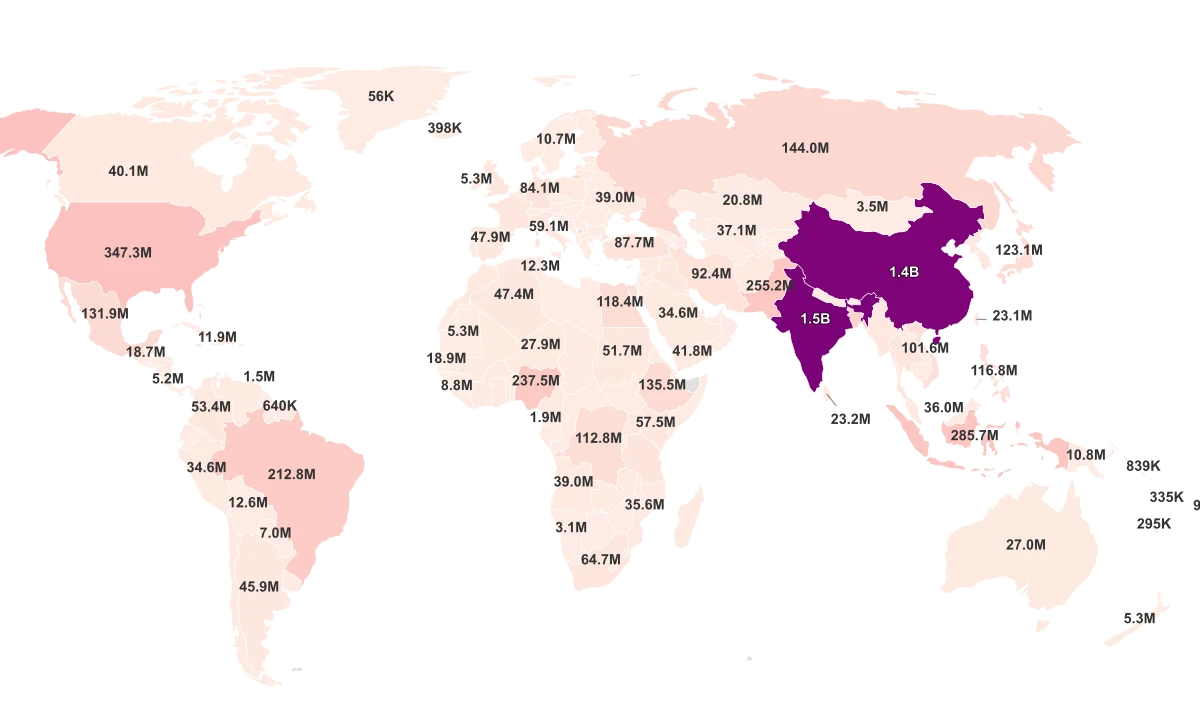
The giants make the point themselves. Russia, the largest country on Earth, is home to about 144 million people, fewer than the United States on a fraction of the comparable footprint, and Canada, second by total area, holds only around 40 million. Meanwhile the world's population leaders, India and China, each with well over a billion residents, are not the area leaders at all, a split Worldometer lays out by listing area and population side by side. Size sets the stage; history, climate and economy decide how many people actually live on it.
The Biggest Countries Are Not the Most Crowded
Plotting total area against population shows a loose scatter, not a line, because how large a country is barely predicts how many people live there.
Sources & Notes
Specifies the land area of a country or region, in square kilometers, excluding bodies of water.
Total number of people.