Mormon Population By State

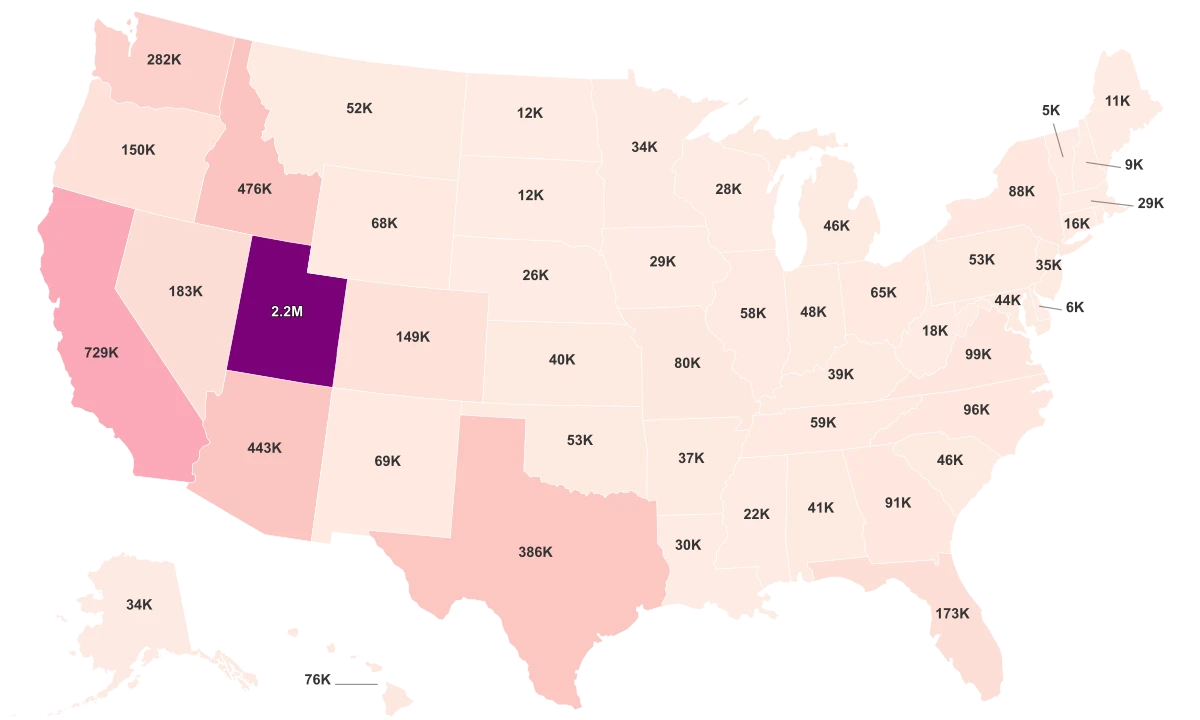
1 |  | Utah | 2,190,610 |
2 |  | California | 728,598 |
3 |  | Idaho | 476,118 |
4 |  | Arizona | 442,879 |
5 |  | Texas | 385,600 |
6 |  | Washington | 281,802 |
7 |  | Nevada | 182,786 |
8 |  | Florida | 172,918 |
9 |  | Oregon | 150,170 |
10 |  | Colorado | 149,186 |
11 |  | Virginia | 98,786 |
12 |  | North Carolina | 95,875 |
13 |  | Georgia | 91,142 |
14 |  | New York | 87,605 |
15 |  | Missouri | 80,440 |
16 |  | Hawaii | 75,635 |
17 |  | New Mexico | 69,432 |
18 |  | Wyoming | 67,691 |
19 |  | Ohio | 64,595 |
20 |  | Tennessee | 59,202 |
21 |  | Illinois | 57,837 |
22 |  | Pennsylvania | 53,025 |
23 |  | Oklahoma | 52,844 |
24 |  | Montana | 52,068 |
25 |  | Indiana | 47,789 |
26 |  | Michigan | 46,044 |
27 |  | South Carolina | 45,810 |
28 |  | Maryland | 44,094 |
29 |  | Alabama | 40,540 |
30 |  | Kansas | 39,793 |
31 |  | Kentucky | 38,535 |
32 |  | Arkansas | 36,630 |
33 |  | New Jersey | 35,453 |
34 |  | Alaska | 33,948 |
35 |  | Minnesota | 33,759 |
36 |  | Louisiana | 29,913 |
37 |  | Iowa | 29,285 |
38 |  | Massachusetts | 28,667 |
39 |  | Wisconsin | 28,430 |
40 |  | Nebraska | 25,935 |
41 |  | Mississippi | 22,297 |
42 |  | West Virginia | 17,557 |
43 |  | Connecticut | 16,030 |
44 |  | North Dakota | 11,682 |
45 |  | South Dakota | 11,601 |
46 |  | Maine | 11,233 |
47 |  | New Hampshire | 8,553 |
48 |  | Delaware | 5,736 |
49 |  | Rhode Island | 4,796 |
50 |  | Vermont | 4,624 |
51 |  | District of Columbia | 3,215 |
Last updated June 24, 2026
Key Takeaways
- Utah leads by a wide margin with about 2.19 million Latter-day Saints on the rolls, roughly three times the next state.
- The District of Columbia sits at the bottom, with about 3,200 members.
- Five states hold over 60% of all U.S. Latter-day Saints, and Utah alone accounts for roughly a third of the national total of about 6.87 million.
- The count is the Church's own membership record, not a head count of who attends or who would call themselves Mormon to a pollster.
The Church Counts Its Own Members, and the Map Leans Hard West
The numbers on this page come straight from the source: The Church of Jesus Christ of Latter-day Saints publishes a member count for every state through its Newsroom, updated for 2025. A higher number simply means more people are on the Church's membership rolls in that state. It is not a score, and it does not mean one state is more devout than another.
The short answer to the title question: Utah has the most Latter-day Saints, about 2.19 million of them, and the District of Columbia has the fewest, around 3,200. Across all 50 states and DC, the rolls add up to roughly 6.87 million members. Between those two ends, the drop-off is steep and fast.
One thing to keep in mind before reading the table: this is a raw count, not a percentage. A big state can post a big number simply because it has a lot of people. That distinction matters most for the state sitting in second place, which is a story in itself.
Five States Hold Three of Every Five Latter-day Saints
For a faith with members in every state, the population is remarkably bunched up. Just five states, Utah, California, Idaho, Arizona, and Texas, account for about 61% of every Latter-day Saint in the country. The other 45 states and DC split what is left.
The concentration gets starker the closer you look at the top. Utah by itself holds close to a third of the entire national total. Add California, and the top two states alone cover more than 40% of all U.S. members.
The bottom of the table tells the mirror-image story. The typical state has only about 46,000 Latter-day Saints, and most states sit in the low tens of thousands or below. Seven states plus the District of Columbia report fewer than 12,000 members each. The shape of this data is a short, tall spike in the Mountain West and a long, flat plain everywhere else.
Utah Stands Alone, and California's Second Place Is a Population Mirage
Utah is not just first. It is in a category of its own. Its 2.19 million members are roughly three times the total of California, the next state in line at about 729,000. No other state comes close to that kind of separation from the pack.
California's runner-up finish is where the raw-count framing can mislead. It places second not because Latter-day Saints make up a large share of Californians, but because California is the most populous state in the country. A big denominator produces a big number even from a thin slice. Nationally, Pew Research Center finds that about 2% of U.S. adults identify as Latter-day Saints, and in a state of nearly 40 million people, 2% is still a large head count.
Utah is the rare place where both readings agree. It leads on the raw count, and it is also one of the few states where Latter-day Saints are a major share of the population. That is what makes it an outlier on this map: most states with a lot of members have a lot of people, but Utah has a lot of members because the faith is woven into the state itself.
The 1847 Wagon Trail Still Shapes the 2025 Map
The geography of this ranking was set nearly two centuries ago. On 24 July 1847, Brigham Young led the first company of Latter-day Saint pioneers into the Salt Lake Valley. "This is the right place," he is said to have declared, and the Church has been headquartered in Salt Lake City ever since. The Mountain West has been the faith's heartland from that day forward.
The regional averages make the tilt unmistakable. States in the West average about 377,000 Latter-day Saints each. The South averages roughly 73,000, the Midwest about 40,000, and the Northeast just under 28,000. The West's per-state average runs more than five times the South's. Pew finds the same pattern from the other direction: about 69% of all U.S. Latter-day Saints live in the West.
Everywhere outside that corridor, the faith is a small minority. New England barely registers. Vermont and Rhode Island each report under 5,000 members, and DC sits lower still. The Church only reached congregations in all 50 states by the mid-20th century, and U.S. membership did not pass one million until 1951. The map you see today is less a snapshot of the present than the long shadow of where the wagons stopped.
What "Membership" Counts, and What It Quietly Leaves Out
There is one more thing worth knowing before you treat these as hard population figures. The Church counts members on its own records, and that is a different thing from counting who shows up on Sunday or who would tell a survey-taker they are Mormon. As the public record of these statistics puts it, official figures "reflect individuals on record rather than measures of belief, participation, or self-identification."
That gap is not small. Because the count tracks names on record rather than active participation, it includes many people who have drifted away. A longtime religion columnist for The Salt Lake Tribune, Peggy Fletcher Stack, estimated back in 2005 that only about one-third of reported members were active. Independent surveys land lower than the rolls too: Pew's self-identification measure puts U.S. Latter-day Saints at about 2% of adults.
None of this means the ranking is wrong. It means it answers a specific question, namely how many people each state has on the Church's books, not how many fill the pews. Read that way, the map is consistent and revealing. Utah's lead is real, the Mountain West concentration is real, and the long thin tail across the rest of the country is real. The number just measures membership as the Church defines it, which is exactly what the title promises.
Sources & Notes
Total number of people who identify as Mormon or members of the Church of Jesus Christ of Latter-day Saints.