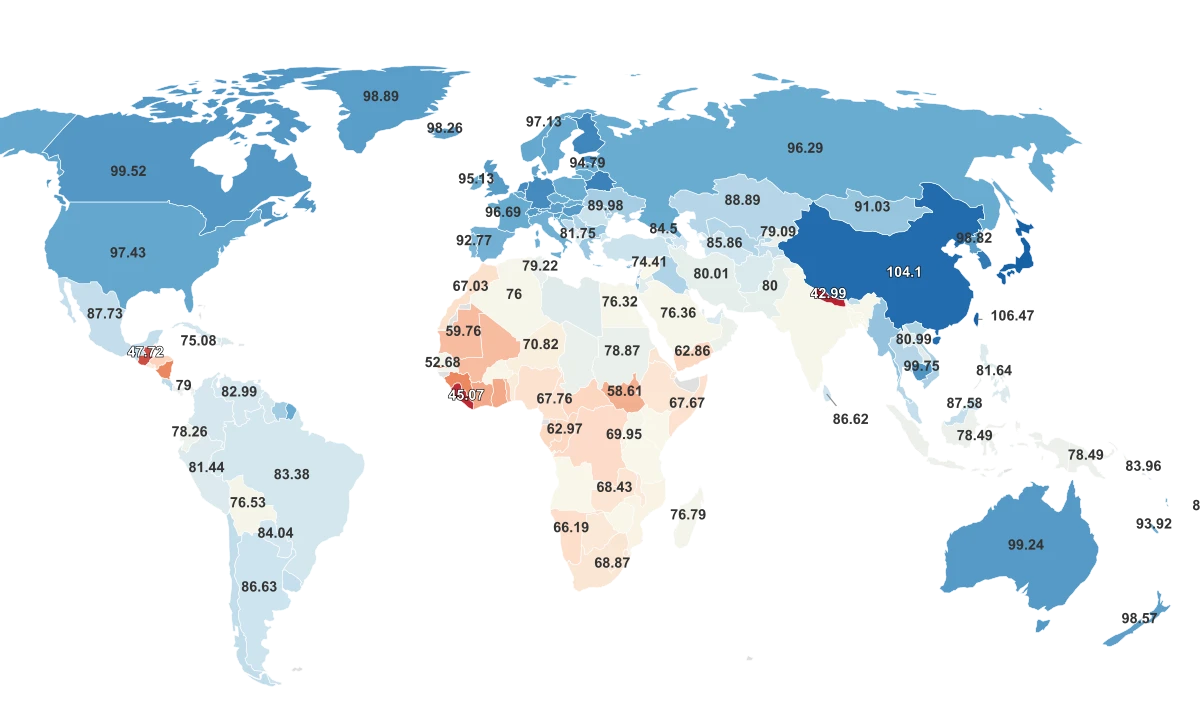
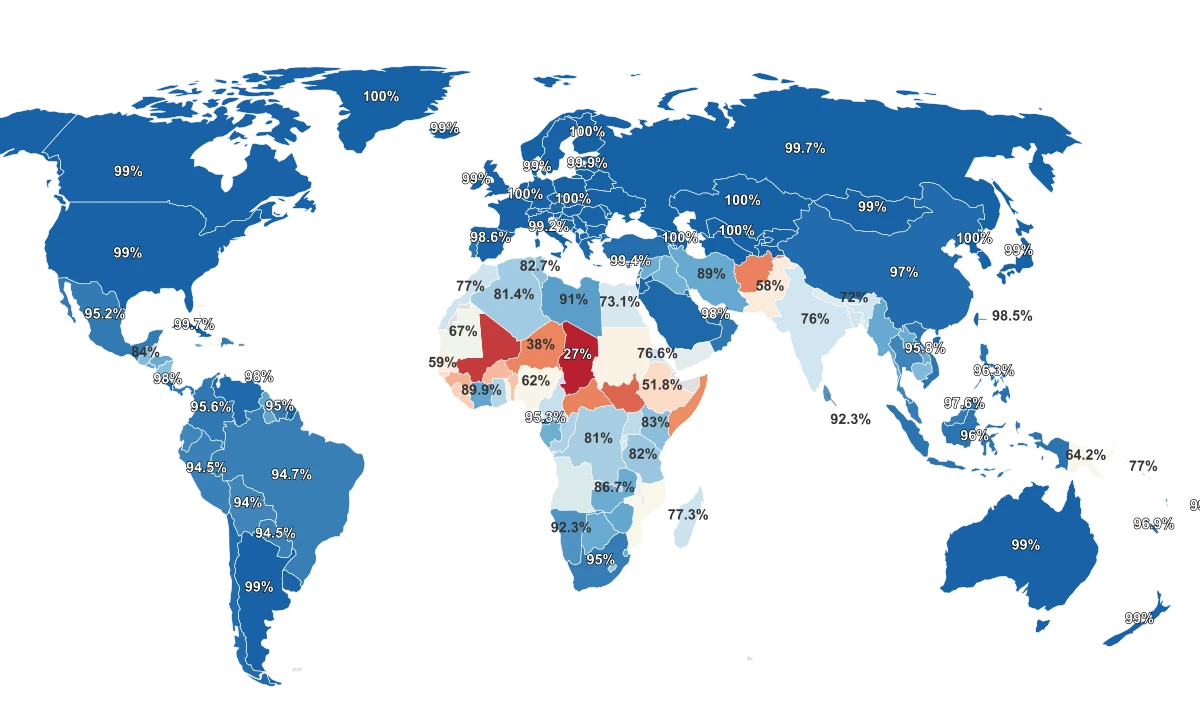
Literacy Rate By Country

1▲24 |  | Slovakia | 100%+0.4 (+0.4%) |
1— |  | Norway | 100% |
1— |  | Andorra | 100% |
1— |  | Liechtenstein | 100% |
1▲6 |  | Uzbekistan | 100%+0.005 (+0.0%) |
1▲11 |  | Guam | 100%+0.211 (+0.2%) |
1▲10 |  | Azerbaijan | 100%+0.195 (+0.2%) |
1▲12 |  | Kazakhstan | 100%+0.212 (+0.2%) |
1▲16 |  | Ukraine | 100%+0.236 (+0.2%) |
1— |  | Luxembourg | 100% |
1— |  | North Korea | 100% |
1▲17 |  | Georgia | 100%+0.24 (+0.2%) |
1— |  | Finland | 100% |
1— |  | Greenland | 100% |
15▼7 |  | Latvia | 99.9%+0.007 (+0.0%) |
15▼6 |  | Estonia | 99.9%+0.076 (+0.1%) |
15▲4 |  | Belarus | 99.9%+0.178 (+0.2%) |
15▲77 |  | San Marino | 99.9%+3.9 (+4.1%) |
19▼4 |  | Tajikistan | 99.8%+0.019 (+0.0%) |
19▼3 |  | Armenia | 99.8%+0.032 (+0.0%) |
19▼9 |  | Lithuania | 99.8%-0.023 (-0.0%) |
19▼5 |  | Poland | 99.8%+0.013 (+0.0%) |
23▼3 |  | Russia | 99.7%-0.02 (-0.0%) |
23▼2 |  | Slovenia | 99.7%-0.015 (-0.0%) |
23▲1 |  | Turkmenistan | 99.7%+0.007 (+0.0%) |
23▼1 |  | Cuba | 99.7%-0.011 (-0.0%) |
27▲5 |  | Moldova | 99.6%+0.356 (+0.4%) |
27— |  | Kyrgyzstan | 99.6%+0.099 (+0.1%) |
27▼4 |  | Barbados | 99.6%-0.1 (-0.1%) |
30▲1 |  | Croatia | 99.4%+0.127 (+0.1%) |
30▼2 |  | Tonga | 99.4%+0.002 (+0.0%) |
30▲3 |  | Cyprus | 99.4%+0.34 (+0.3%) |
33▲1 |  | Italy | 99.2%+0.184 (+0.2%) |
34▲90 |  | Fiji | 99.1%+5.4 (+5.8%) |
34▲1 |  | Samoa | 99.1%+0.085 (+0.1%) |
34▼5 |  | Hungary | 99.1%-0.281 (-0.3%) |
37▼1 |  | Sweden | 99% |
37▼1 |  | Canada | 99% |
37▲27 |  | Argentina | 99%+0.91 (+0.9%) |
37▲40 |  | Albania | 99%+1.45 (+1.5%) |
37▼1 |  | Switzerland | 99% |
37▼1 |  | New Zealand | 99% |
37▲100 |  | Micronesia | 99%+10 (+11%) |
37▼1 |  | Japan | 99% |
37▼1 |  | Monaco | 99% |
37▼1 |  | United Kingdom | 99% |
37▲20 |  | Montenegro | 99%+0.28 (+0.3%) |
37▼1 |  | Belgium | 99% |
37▼1 |  | Iceland | 99% |
37— |  | Tuvalu | 99% |
37▼1 |  | Denmark | 99% |
37▼1 |  | France | 99% |
37▼1 |  | United States | 99% |
37▲17 |  | Antigua and Barbuda | 99%+0.05 (+0.1%) |
37— |  | Czech Republic | 99% |
37▼1 |  | Germany | 99% |
37▲29 |  | Serbia | 99%+0.997 (+1.0%) |
37▼1 |  | Australia | 99% |
37▼1 |  | Netherlands | 99% |
37▲24 |  | Mongolia | 99%+0.632 (+0.6%) |
37▼1 |  | Ireland | 99% |
62▼6 |  | Romania | 98.9%+0.143 (+0.1%) |
62▼7 |  | Cayman Islands | 98.9%+0.032 (+0.0%) |
64▲7 |  | South Korea | 98.8%+0.834 (+0.9%) |
64▼5 |  | Uruguay | 98.8%+0.358 (+0.4%) |
66▼3 |  | Spain | 98.6%+0.485 (+0.5%) |
66▲26 |  | Grenada | 98.6%+2.6 (+2.7%) |
68▲23 |  | Taiwan | 98.5%+2.4 (+2.5%) |
69▼9 |  | Bulgaria | 98.4%+0.011 (+0.0%) |
69▼4 |  | Jordan | 98.4%+0.386 (+0.4%) |
69▲3 |  | North Macedonia | 98.4%+0.556 (+0.6%) |
72▼10 |  | Marshall Islands | 98.3%+0.035 (+0.0%) |
73▼20 |  | Trinidad and Tobago | 98%-0.97 (-1.0%) |
73▲3 |  | Costa Rica | 98%+0.353 (+0.4%) |
73▲21 |  | Bahrain | 98%+2.28 (+2.4%) |
73▲5 |  | Aruba | 98%+0.476 (+0.5%) |
73▼6 |  | Austria | 98% |
73▲55 |  | United Arab Emirates | 98%+5.01 (+5.4%) |
73▼15 |  | Bosnia and Herzegovina | 98%-0.486 (-0.5%) |
73▲12 |  | Palestine | 98%+1.33 (+1.4%) |
81▼51 |  | Maldives | 97.9%-1.42 (-1.4%) |
81▲23 |  | Greece | 97.9%+2.61 (+2.7%) |
83▼3 |  | Israel | 97.8%+0.7 (+0.7%) |
84▲2 |  | Brunei | 97.6%+0.943 (+1.0%) |
84▲27 |  | Saudi Arabia | 97.6%+2.76 (+2.9%) |
86▼2 |  | Singapore | 97.5%+0.725 (+0.7%) |
86▲16 |  | Venezuela | 97.5%+2.1 (+2.2%) |
88— |  | Macau | 97.1% |
89▼16 |  | Saint Kitts and Nevis | 97%-0.8 (-0.8%) |
89— |  | China | 97%+0.643 (+0.7%) |
89▼2 |  | Chile | 97%+0.372 (+0.4%) |
89▲7 |  | Saint Vincent and the Grenadines | 97%+1.37 (+1.4%) |
89▼10 |  | American Samoa | 97%-0.344 (-0.4%) |
94▼11 |  | New Caledonia | 96.9%-0.038 (-0.0%) |
95— |  | Turkey | 96.7%+1.01 (+1.1%) |
96▼70 |  | Palau | 96.6%-2.92 (-2.9%) |
97▼7 |  | Kuwait | 96.5%+0.382 (+0.4%) |
98▼10 |  | Philippines | 96.3%-0.318 (-0.3%) |
99▼2 |  | Bahamas | 96%+0.4 (+0.4%) |
99▲1 |  | Indonesia | 96%+0.562 (+0.6%) |
101— |  | Portugal | 95.9%+0.472 (+0.5%) |
101▲2 |  | Seychelles | 95.9%+0.579 (+0.6%) |
103▲14 |  | Vietnam | 95.8%+1.29 (+1.4%) |
104▲3 |  | Panama | 95.7%+0.662 (+0.7%) |
104▲19 |  | Oman | 95.7%+1.73 (+1.8%) |
106▲8 |  | Colombia | 95.6%+1.02 (+1.1%) |
107▲24 |  | Dominican Republic | 95.5%+3.03 (+3.3%) |
108▼3 |  | Equatorial Guinea | 95.3%+0.104 (+0.1%) |
109▲6 |  | Mexico | 95.2%+0.654 (+0.7%) |
110▲10 |  | Lebanon | 95%+0.949 (+1.0%) |
110▲2 |  | Malaysia | 95%+0.363 (+0.4%) |
110▲3 |  | South Africa | 95%+0.402 (+0.4%) |
110— |  | Nauru | 95% |
110▼12 |  | Suriname | 95%-0.539 (-0.6%) |
115▲4 |  | Malta | 94.9%+0.833 (+0.9%) |
116▲16 |  | Sao Tome and Principe | 94.8%+3.05 (+3.3%) |
117▲13 |  | Brazil | 94.7%+2.11 (+2.3%) |
118▼19 |  | Paraguay | 94.5%-1.04 (-1.1%) |
118— |  | Peru | 94.5%+0.126 (+0.1%) |
120▲2 |  | Thailand | 94.1%+0.117 (+0.1%) |
121▼15 |  | Bolivia | 94%-1.14 (-1.2%) |
122▼6 |  | Ecuador | 93.9%-0.615 (-0.7%) |
123▼48 |  | Qatar | 93.5%-4.26 (-4.4%) |
124▲2 |  | Puerto Rico | 92.4%-0.929 (-1.0%) |
125▲9 |  | Namibia | 92.3%+1.48 (+1.6%) |
125▲4 |  | Sri Lanka | 92.3%-0.314 (-0.3%) |
127▲8 |  | Mauritius | 92.2%+1.58 (+1.7%) |
128▼7 |  | Dominica | 92%-2 (-2.1%) |
129▲4 |  | Libya | 91%-0.389 (-0.4%) |
130▲9 |  | Cape Verde | 90.8%+2.33 (+2.6%) |
131▲12 |  | Guyana | 90%+2.46 (+2.8%) |
131▲5 |  | Saint Lucia | 90%-0.1 (-0.1%) |
131▲11 |  | El Salvador | 90%+2.35 (+2.7%) |
134▲63 |  | Ivory Coast | 89.9%+46.63 (+108%) |
135▲11 |  | Zimbabwe | 89.7%+2.83 (+3.3%) |
136▼9 |  | Myanmar | 89.1%-3.99 (-4.3%) |
136▲14 |  | Vanuatu | 89.1%+4.04 (+4.8%) |
138▲6 |  | Eswatini | 89%+1.53 (+1.7%) |
138▲7 |  | Iran | 89%+1.83 (+2.1%) |
140▼2 |  | Jamaica | 88.7%+0.2 (+0.2%) |
141— |  | Botswana | 88.5%+0.276 (+0.3%) |
141▼1 |  | Honduras | 88.5%+0.075 (+0.1%) |
143▲15 |  | Laos | 88%+8.13 (+10%) |
144▲5 |  | Zambia | 86.7%+1.58 (+1.9%) |
145▲2 |  | Syria | 86.4%+0.096 (+0.1%) |
146▲6 |  | Gabon | 86%+2.76 (+3.3%) |
147▲12 |  | Iraq | 85.6%+5.88 (+7.4%) |
148▲15 |  | Cambodia | 84%+5.65 (+7.2%) |
148▲14 |  | Guatemala | 84%+4.93 (+6.2%) |
150▲4 |  | Nicaragua | 83%+0.528 (+0.6%) |
150▲15 |  | Kenya | 83%+4.98 (+6.4%) |
152▲3 |  | Tunisia | 82.7%+1.65 (+2.0%) |
153▲3 |  | Tanzania | 82%+1.64 (+2.0%) |
153▲8 |  | Lesotho | 82%+2.64 (+3.3%) |
155▲5 |  | Algeria | 81.4%+1.79 (+2.3%) |
156▲10 |  | DR Congo | 81%+3.78 (+4.9%) |
156▼3 |  | Belize | 81%-1.78 (-2.1%) |
158— |  | Republic of the Congo | 80.6% |
159▲8 |  | Ghana | 80%+3.42 (+4.5%) |
160▲11 |  | Uganda | 79%+5.19 (+7.0%) |
161▲8 |  | Cameroon | 78%+3.01 (+4.0%) |
162▲19 |  | Madagascar | 77.3%+12.64 (+20%) |
163▲10 |  | Morocco | 77%+5.29 (+7.4%) |
163▼12 |  | Solomon Islands | 77%-7.1 (-8.4%) |
165▲5 |  | Eritrea | 76.6%+2.75 (+3.7%) |
166▼18 |  | Burundi | 76%-9.5 (-11%) |
166▲6 |  | India | 76%+3.77 (+5.2%) |
168▲6 |  | Rwanda | 75.9%+4.66 (+6.5%) |
169▲15 |  | Bangladesh | 74.9%+13.41 (+22%) |
170▼2 |  | Egypt | 73.1%-2.74 (-3.6%) |
171▲11 |  | Bhutan | 72%+8.09 (+13%) |
171▲4 |  | Angola | 72%+0.836 (+1.2%) |
173▲7 |  | Nepal | 71.2%+6.54 (+10%) |
174▲2 |  | Yemen | 70.1%+0.138 (+0.2%) |
175— |  | Timor Leste | 68.1% |
176▲3 |  | Malawi | 68%+2.04 (+3.1%) |
177▲16 |  | Mauritania | 67%+14.88 (+29%) |
178— |  | Togo | 66.5%-0.038 (-0.1%) |
179▲4 |  | Papua New Guinea | 64.2%+0.767 (+1.2%) |
180▲8 |  | Mozambique | 63.4%+4.56 (+7.8%) |
181▲6 |  | Nigeria | 62%+2.43 (+4.1%) |
181▼17 |  | Comoros | 62%-16.14 (-21%) |
183▲2 |  | Haiti | 61.7%+1.01 (+1.7%) |
184▲5 |  | Sudan | 60.7%+2.1 (+3.6%) |
185▲7 |  | Gambia | 59%+3.43 (+6.2%) |
186▲4 |  | Pakistan | 58%+1.56 (+2.8%) |
186▲5 |  | Senegal | 58%+2.38 (+4.3%) |
188▼2 |  | Guinea Bissau | 52.9%-6.87 (-11%) |
189▲5 |  | Ethiopia | 51.8%+2.77 (+5.6%) |
190▲5 |  | Sierra Leone | 48.6%+0.168 (+0.3%) |
191▲5 |  | Liberia | 48.3%+0.7 (+1.5%) |
192▲7 |  | Benin | 47%+8.55 (+22%) |
193▲8 |  | Burkina Faso | 46%+8.25 (+22%) |
194▲11 |  | Guinea | 45.3%+14.83 (+49%) |
195▲5 |  | Somalia | 41%+3.2 (+8.5%) |
196▲10 |  | Niger | 38%+18.9 (+99%) |
197▲5 |  | Central African Republic | 37.5%+0.747 (+2.0%) |
198— |  | Afghanistan | 37.3% |
199▲5 |  | South Sudan | 34.5%+2.52 (+7.9%) |
200▲3 |  | Mali | 31%-2.07 (-6.3%) |
201▼3 |  | Chad | 27%-13.02 (-33%) |
Last updated March 31, 2026
More Than a Billion Adults Still Cannot Read
The World Bank defines adult literacy as the share of people aged 15 and above who can both read and write a short, simple statement about their everyday life. That sounds like a low bar. For most of the developed world, it is: 14 countries in this dataset report 100% literacy, including Norway, Finland, Slovakia, and Uzbekistan. Dozens more sit at 99%.
But the bottom of the ranking tells a different story. Chad reports a literacy rate of just 27%, meaning nearly three out of four adults cannot read a sentence. Mali sits at 31%. South Sudan at 34.5%. The gap between the top and bottom of this ranking is 73 percentage points, one of the widest in any human development metric.
The distribution is sharply lopsided. The median country sits at 95.9%, but the mean is dragged down to 88.2% by a cluster of low outliers almost entirely concentrated in Sub-Saharan Africa. Most of the world has crossed the 90% threshold. The crisis is concentrated in a narrow band of countries that have not.
Most of the World Held Steady, but a Few Countries Surged
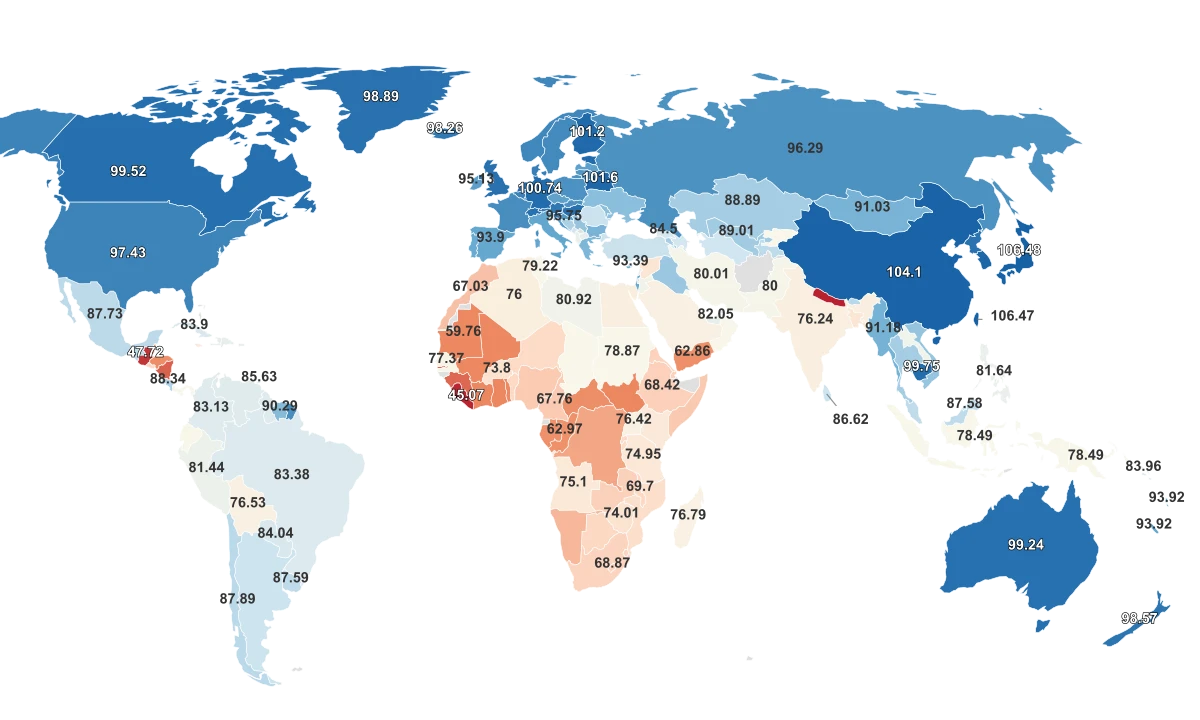
Total Literacy Rate change from 2021 to 2025. Ivory Coast more than doubled its reported rate while several countries saw modest declines.
Showing 51 of 193 regions · Sorted by: Highest to Lowest · 142 not shown
The 2021-to-2025 comparison reveals a few dramatic movers. Ivory Coast jumped from 43.3% to 89.9%, a change driven by the government's introduction of compulsory free education for ages six to 16, expanded school infrastructure, and catch-up literacy programs under its National Development Plan. Niger nearly doubled its reported rate from 19.1% to 38%, though it remains the second-lowest in the dataset. On the other end, a handful of countries saw small declines, likely reflecting updated census methodologies rather than actual regression.
All Metrics
The Sahel Is Ground Zero for the Global Literacy Crisis
If you drew a line across the Sahel, the semi-arid belt stretching from Senegal to Sudan, you would capture nearly every country at the bottom of this ranking. Chad (27%), Mali (31%), and South Sudan (34.5%) anchor the very bottom. Just above them, Afghanistan (37.3%), Central African Republic (37.5%), and Niger (38%) all fall below 40%.
Widen the lens slightly and the pattern holds. Somalia (41%), Guinea (45.3%), and Burkina Faso (46%) bring the total to nine countries below the halfway mark. Eight of those nine are in Sub-Saharan Africa.
The pattern is not random. It follows conflict, poverty, and the near-absence of functioning school systems. A 2022 Brookings Institution analysis found that the Sahel's overlapping crises, armed insurgencies, climate-driven displacement, and chronic government underfunding, have created what education researchers call "learning poverty": children who are technically enrolled in school but leave without basic reading or math skills.
Countries Where Children Stay in School Longer Have Higher Literacy Rates
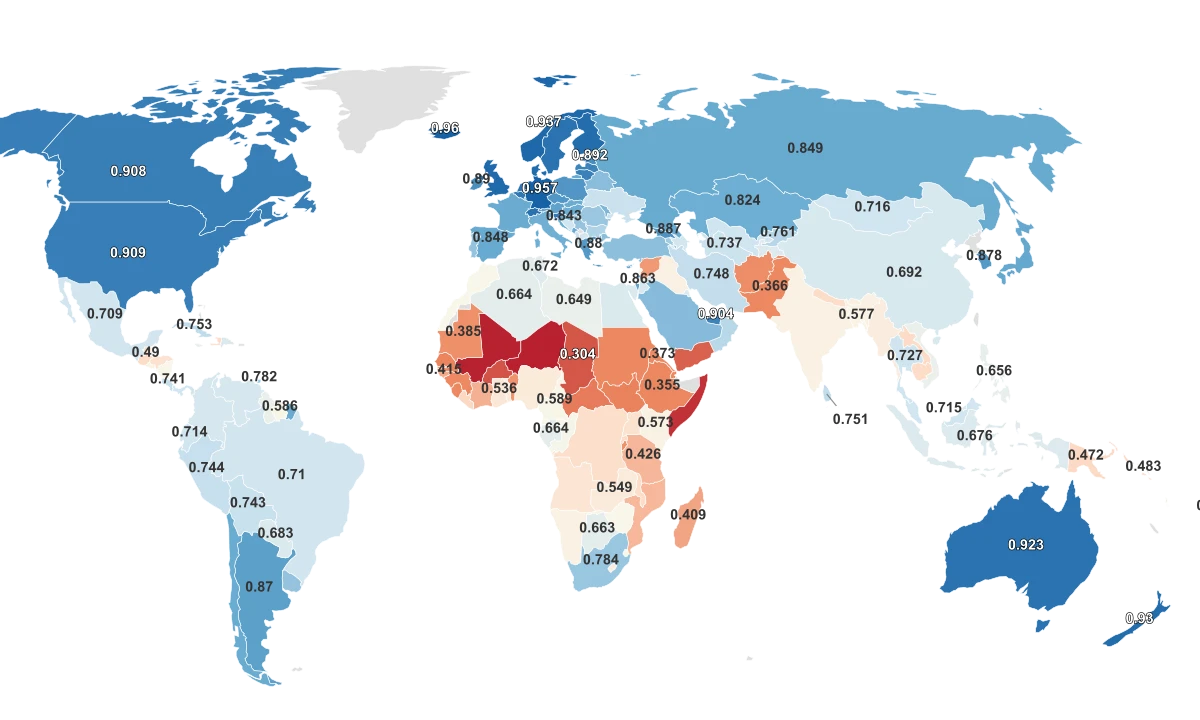
Total Literacy Rate vs. Mean Years of Schooling across 190 countries, showing a tight relationship between education access and adult reading ability.
The scatter plot makes the connection visible. Niger, where adults average just 1.4 years of schooling, sits at the bottom of both axes. Mali averages 1.6 years. Chad averages 2.3. At the other end, Germany (14.3 years), Canada (13.9), and the United States (13.9) cluster near 100% literacy. The relationship is not perfect: Burundi reports 76% literacy despite averaging only 3.5 years of schooling, suggesting its census methodology may define literacy more loosely. But the overall pattern is unmistakable. Where children do not stay in school, adults cannot read.
The structural barriers are steep. In the Sahel, armed groups have forced thousands of schools to close. Teachers are scarce, especially outside cities. Families that depend on subsistence farming often cannot spare children for the classroom. And even when schools exist, they may lack walls, textbooks, or running water. The result is a cycle: low literacy limits economic productivity, which limits the tax revenue available to fund schools, which keeps literacy low.
The Countries Where Women Are Shut Out
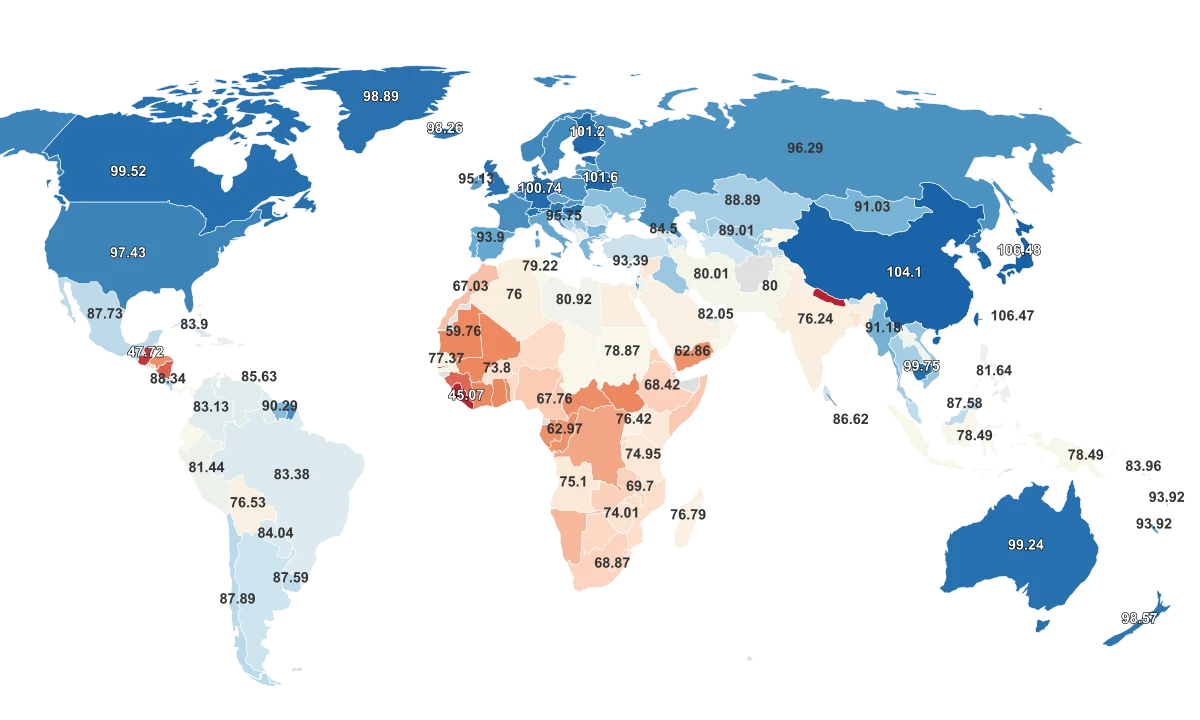
The gap between male and female literacy rates is one of the starkest inequalities in the dataset. In Yemen, men read at 85.1% while women read at 55%. That is a 30.1 percentage-point gap. In Guinea, the gap is 29.9 points. In Afghanistan, it is 29.5 points: 52.1% of men can read, but only 22.6% of women, the lowest female literacy rate of any country in the dataset.
Afghanistan is the only country in the world that has formally banned girls from attending secondary school and university. The Taliban's decree, imposed after the 2021 takeover, reversed two decades of progress. According to UNESCO, 78% of young Afghan women are now neither in education, employment, nor training. The country's female literacy rate, already among the lowest before the ban, is almost certain to fall further as a generation of girls grows up without access to classrooms.
The gender divide elsewhere in the bottom of the rankings reflects a different set of barriers. In Chad, female literacy is just 18.2%, compared to 35.4% for men. In Mali, the split is 25.7% versus 46.2%. In these countries, the gap is driven less by policy bans and more by the economics of poverty: when families can only afford to send one child to school, sons are prioritized. Early marriage pulls girls out of education, particularly in rural areas. And a shortage of female teachers discourages families from enrolling daughters in the first place.
But the gender gap is not universal, and it does not always favor men. In Jamaica, women are more literate than men by 9.1 percentage points: 93.1% to 84%. Malta shows a 3-point female advantage. Qatar, Philippines, Namibia, and Zimbabwe all report higher female than male literacy. In much of the Caribbean and parts of Southeast Asia, girls outperform boys in school enrollment and completion, a pattern that is beginning to reverse the traditional direction of the gap.
Asking "Can You Read?" Does Not Mean the Same Thing Everywhere
Every number in this ranking comes from the same source: the World Bank's compilation of national literacy statistics, drawn primarily from population censuses and household surveys. But the way countries collect that data varies enormously, and those differences matter more than most readers realize.
The most common method is a simple question in a national census: "Can you read and write?" The respondent, or sometimes the head of the household answering on behalf of everyone, says yes or no. This self-reporting approach is cheap and scalable, but it consistently overestimates literacy. People tend to say they can read even when their skills are minimal, and household heads may over-report for family members.
A second approach skips the question entirely and infers literacy from years of schooling. If a person completed a certain grade level, they are counted as literate. The threshold varies wildly. According to UNESCO, Greece considers anyone who has completed six years of primary education to be literate. Paraguay sets the bar at just two years. As Our World in Data notes, "schooling does not produce literacy the same way everywhere," and in many lower-income countries, a large share of students who complete primary school still cannot read a simple paragraph.
The practical consequence is that the 99% literacy rates reported by most wealthy nations, including the United States, United Kingdom, and Germany, are not based on anyone actually taking a reading test. They are estimates derived from educational attainment data. When countries like the U.S. do conduct direct literacy assessments, the results are more nuanced: a 2020 National Center for Education Statistics survey found that roughly 21% of American adults read at or below a basic level, a figure that never appears in the international literacy statistics. The 99% and the 21% are measuring different things, and both are true at the same time.
Sources & Notes
% of the total adult population (ages 15 and above) who can both read and write short, simple statements in their everyday life.
% of the total male population (ages 15 and above) who can both read and write short, simple statements in their everyday life.
% of the total female population (ages 15 and above) who can both read and write short, simple statements in their everyday life.
Average number of years of education received by people ages 25 and older, converted from education attainment levels using official durations of each level.