Crime Rate by Country

1— |  | Haiti | 81 |
2— |  | Papua New Guinea | 80.7-0.09 (-0.1%) |
3▼2 |  | Venezuela | 80.5-3.26 (-3.9%) |
4— |  | Afghanistan | 75.2 |
5▼2 |  | South Africa | 74.6-2.26 (-2.9%) |
6▼1 |  | Honduras | 71.9-2.64 (-3.5%) |
7▼1 |  | Trinidad and Tobago | 71-0.63 (-0.9%) |
8▲3 |  | Syria | 68.4+1.22 (+1.8%) |
9▲1 |  | Jamaica | 67.4-0.02 (-0.0%) |
10▲2 |  | Peru | 66.7-0.02 (-0.0%) |
11▼4 |  | Guyana | 66.4-2.34 (-3.4%) |
12▲1 |  | Angola | 66.3-0.18 (-0.3%) |
13— |  | DR Congo | 66.2 |
14▲2 |  | Nigeria | 66.1+2.04 (+3.2%) |
15▼1 |  | Cameroon | 65.5+0.26 (+0.4%) |
16▲11 |  | Bolivia | 64.6+6.83 (+12%) |
17▼8 |  | Brazil | 64.2-3.29 (-4.9%) |
18▼3 |  | Namibia | 63.6-1.61 (-2.5%) |
19▼1 |  | Argentina | 63.3-0.52 (-0.8%) |
20▲13 |  | Somalia | 63.2+7.16 (+13%) |
21— |  | Yemen | 63 |
22▲15 |  | Ecuador | 62.6+7.37 (+13%) |
23▼6 |  | Bangladesh | 61.5-2.4 (-3.8%) |
24▼5 |  | Puerto Rico | 61.3-1.54 (-2.5%) |
25— |  | Zimbabwe | 61.2+1.9 (+3.2%) |
26— |  | Mozambique | 61 |
26▲4 |  | Colombia | 61+4.13 (+7.3%) |
28▲13 |  | Chile | 60.5+7.08 (+13%) |
29▼7 |  | Dominican Republic | 60.4-0.62 (-1.0%) |
30▲19 |  | Paraguay | 60.1+10.73 (+22%) |
31▼5 |  | Guatemala | 57.7-0.97 (-1.7%) |
32▼12 |  | Bahamas | 56.9-5.16 (-8.3%) |
32▼4 |  | Fiji | 56.9-0.72 (-1.2%) |
34▼26 |  | El Salvador | 56.7-11.09 (-16%) |
35▼14 |  | Libya | 56.4-5.38 (-8.7%) |
36▼13 |  | Kenya | 55.8-4.34 (-7.2%) |
37— |  | Ivory Coast | 55.7 |
38▲6 |  | France | 55.6+3.61 (+6.9%) |
39▼3 |  | Maldives | 54.1-1.24 (-2.2%) |
39▼7 |  | Uganda | 54.1-2.02 (-3.6%) |
41▼3 |  | Costa Rica | 53.7-0.52 (-1.0%) |
42▼7 |  | Tanzania | 53.4-2.6 (-4.6%) |
43▼4 |  | Mexico | 53.2-0.99 (-1.8%) |
44▼1 |  | Algeria | 52.9+0.87 (+1.7%) |
45— |  | Uruguay | 52.3+0.57 (+1.1%) |
46▲1 |  | Belize | 52.1+1.71 (+3.4%) |
47▼17 |  | Kyrgyzstan | 52-4.87 (-8.6%) |
48▼14 |  | Mongolia | 51.7-4.31 (-7.7%) |
49▲12 |  | Myanmar | 51.6+5.09 (+11%) |
50▼8 |  | Botswana | 50.9-2.08 (-3.9%) |
51▲4 |  | Nicaragua | 50.8+2.91 (+6.1%) |
52▼4 |  | Iran | 50.5+1.12 (+2.3%) |
53▼3 |  | Ethiopia | 50.4+1.1 (+2.2%) |
54▼8 |  | Cambodia | 50.2-0.93 (-1.8%) |
55▲15 |  | Belgium | 49.5+4.92 (+11%) |
56▼5 |  | Mauritius | 49.4+0.52 (+1.1%) |
57▼1 |  | United States | 49.2+1.39 (+2.9%) |
58▼34 |  | Belarus | 49.1-10.48 (-18%) |
59▼30 |  | Malaysia | 48.6-8.69 (-15%) |
59▲8 |  | Ireland | 48.6+3.09 (+6.8%) |
61▲16 |  | New Zealand | 48.5+5.62 (+13%) |
62▲2 |  | United Kingdom | 48.4+2.33 (+5.1%) |
63▼9 |  | Sweden | 48.1+0.1 (+0.2%) |
64▼12 |  | Morocco | 47.5-1.16 (-2.4%) |
65▲10 |  | Australia | 47.4+4.37 (+10%) |
66▲3 |  | Italy | 47.2+2.35 (+5.2%) |
67▼10 |  | Ukraine | 47-0.42 (-0.9%) |
68▼9 |  | Egypt | 46.9+0.07 (+0.1%) |
68▼8 |  | Lebanon | 46.9+0.13 (+0.3%) |
70▼4 |  | Greece | 46.4+0.55 (+1.2%) |
71▼6 |  | Indonesia | 46.1+0.17 (+0.4%) |
72▲10 |  | Canada | 45.8+3.91 (+9.3%) |
72▼14 |  | Ghana | 45.8-1.18 (-2.5%) |
74— |  | Zambia | 45.6+1.98 (+4.5%) |
74▲7 |  | Sudan | 45.6+3.26 (+7.7%) |
74▼34 |  | Kazakhstan | 45.6-8.17 (-15%) |
77▼4 |  | Tunisia | 45+1.31 (+3.0%) |
78— |  | Barbados | 44.9 |
79▼17 |  | Moldova | 44.7-1.65 (-3.6%) |
80▼2 |  | Albania | 44.2+1.67 (+3.9%) |
80▼9 |  | India | 44.2-0.23 (-0.5%) |
82▼2 |  | Philippines | 43.4+0.94 (+2.2%) |
83▼11 |  | Palestine | 43.2-0.54 (-1.2%) |
84▲1 |  | Malta | 43+2.61 (+6.5%) |
85▼17 |  | Panama | 42.7-2.45 (-5.4%) |
86▼7 |  | Pakistan | 42.4-0.11 (-0.3%) |
87▼4 |  | Sri Lanka | 42.3+0.91 (+2.2%) |
88▼35 |  | Iraq | 41.9-6.52 (-13%) |
89▼1 |  | Turkey | 41.4+1.78 (+4.5%) |
89▲1 |  | North Macedonia | 41.4+2.28 (+5.8%) |
91▼15 |  | Bosnia and Herzegovina | 41.2-1.79 (-4.2%) |
92— |  | Kosovo | 41.1 |
93▼30 |  | Vietnam | 40.4-5.79 (-13%) |
94▼7 |  | Jordan | 39.8-0.16 (-0.4%) |
95— |  | Germany | 39.6+3.81 (+11%) |
96▼10 |  | Russia | 38.4-1.59 (-4.0%) |
97▲5 |  | Spain | 37.2+3.88 (+12%) |
97▼4 |  | Serbia | 37.2-0.9 (-2.4%) |
99▼10 |  | Thailand | 36.8-2.55 (-6.5%) |
100▼9 |  | Latvia | 36.6-2.17 (-5.6%) |
101▼7 |  | Nepal | 36.1+0.09 (+0.2%) |
102▼10 |  | Bulgaria | 35.9-2.31 (-6.0%) |
103▲8 |  | Cuba | 35.4+7.07 (+25%) |
104▼20 |  | Montenegro | 35-6.18 (-15%) |
105▼8 |  | Luxembourg | 34-0.13 (-0.4%) |
106▼10 |  | Hungary | 33.7-0.66 (-1.9%) |
107▼8 |  | Lithuania | 33-0.42 (-1.3%) |
108▼10 |  | Norway | 32.8-0.92 (-2.7%) |
109▼10 |  | Kuwait | 32.7-0.72 (-2.2%) |
109▼4 |  | Cyprus | 32.7+1.42 (+4.5%) |
111▲1 |  | Romania | 32.6+4.3 (+15%) |
112▼3 |  | Portugal | 32.4+2.49 (+8.3%) |
113▼10 |  | Azerbaijan | 31.8-0.22 (-0.7%) |
114▼10 |  | Israel | 31.7+0.23 (+0.7%) |
115▼8 |  | Slovakia | 31+0.63 (+2.1%) |
116— |  | Cayman Islands | 30.6 |
117▼7 |  | Brunei | 29.4+0.4 (+1.4%) |
118▼12 |  | Poland | 28.7-1.8 (-5.9%) |
119— |  | Austria | 28.3+2.76 (+11%) |
120▼4 |  | South Korea | 26.9+0.22 (+0.8%) |
121▲10 |  | Switzerland | 26.7+5.08 (+23%) |
122▼23 |  | Uzbekistan | 26.6-6.82 (-20%) |
122▼2 |  | Czech Republic | 26.6+1.08 (+4.2%) |
124▼10 |  | Finland | 26.5-1.09 (-4.0%) |
125▼3 |  | Rwanda | 26.4+1.51 (+6.1%) |
126▼9 |  | Denmark | 26-0.22 (-0.8%) |
126— |  | Georgia | 26+2.62 (+11%) |
128▼4 |  | Iceland | 25.8+2.05 (+8.6%) |
128▼13 |  | Netherlands | 25.8-1.36 (-5.0%) |
130▼7 |  | Croatia | 25.4+0.81 (+3.3%) |
131— |  | Monaco | 24.7 |
132▼4 |  | Slovenia | 24.4+2.12 (+9.5%) |
133▼15 |  | Bahrain | 23.8-1.84 (-7.2%) |
134▼13 |  | Saudi Arabia | 23.7-1.53 (-6.1%) |
135▼10 |  | Estonia | 23.5-0.21 (-0.9%) |
135▼27 |  | China | 23.5-6.64 (-22%) |
137▼8 |  | Japan | 22.7+0.51 (+2.3%) |
138▼25 |  | Singapore | 22.6-5.36 (-19%) |
139▼12 |  | Armenia | 22.4-0.39 (-1.7%) |
140▼10 |  | Hong Kong | 21.5-0.5 (-2.3%) |
141▼8 |  | Isle Of Man | 20.9+1.65 (+8.6%) |
142▼10 |  | Oman | 18.6-1.74 (-8.6%) |
143— |  | Macau | 18.2 |
144▼10 |  | Taiwan | 17+1.54 (+10.0%) |
145▼9 |  | Qatar | 15.4+3.27 (+27%) |
146— |  | Andorra | 15.2 |
147▼12 |  | United Arab Emirates | 14.8-0.43 (-2.8%) |
Last updated June 24, 2026
Key Takeaways
- Haiti tops the 2025 Crime Index at 81 out of 100, the highest perceived-crime score in the dataset, with Papua New Guinea and Venezuela close behind.
- The United Arab Emirates sits lowest at 14.8, alongside Qatar and Andorra, a span of more than 66 points from the top of the table.
- The index measures how unsafe residents feel, not crimes recorded by police, so it can diverge sharply from official statistics.
- Recorded homicide explains only about a third of where a country lands on the index, which means most of the score reflects something other than lethal violence.
All Metrics
What the Crime Index Actually Counts
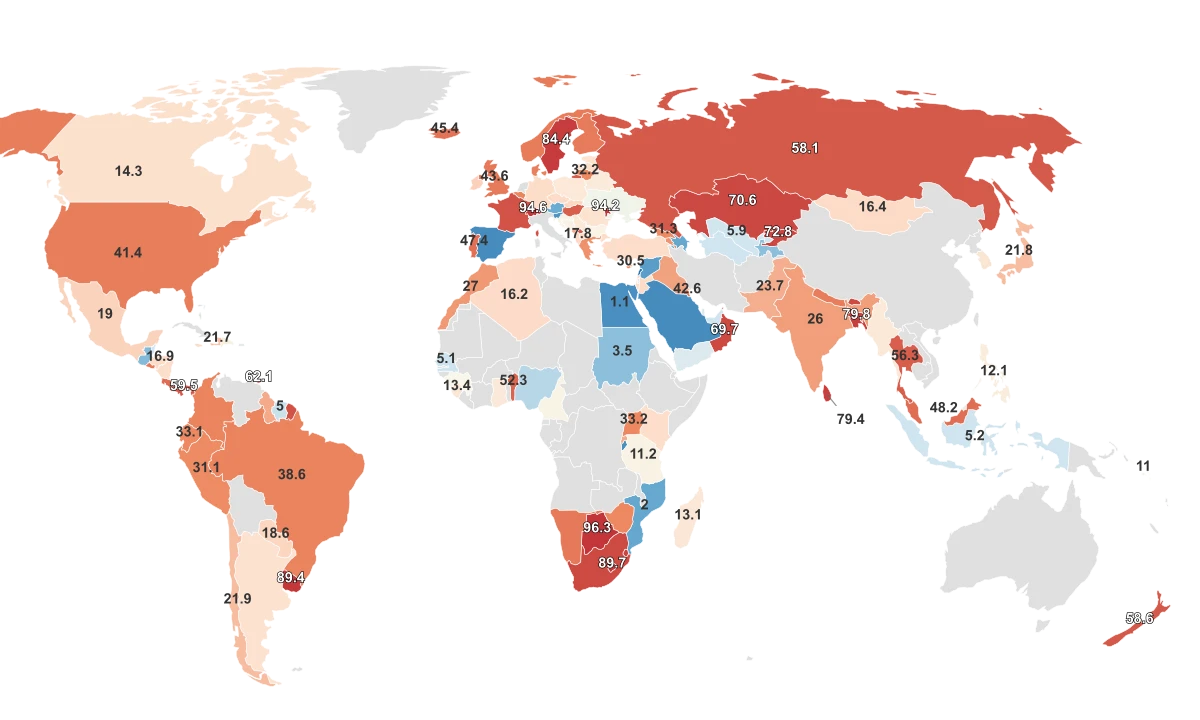
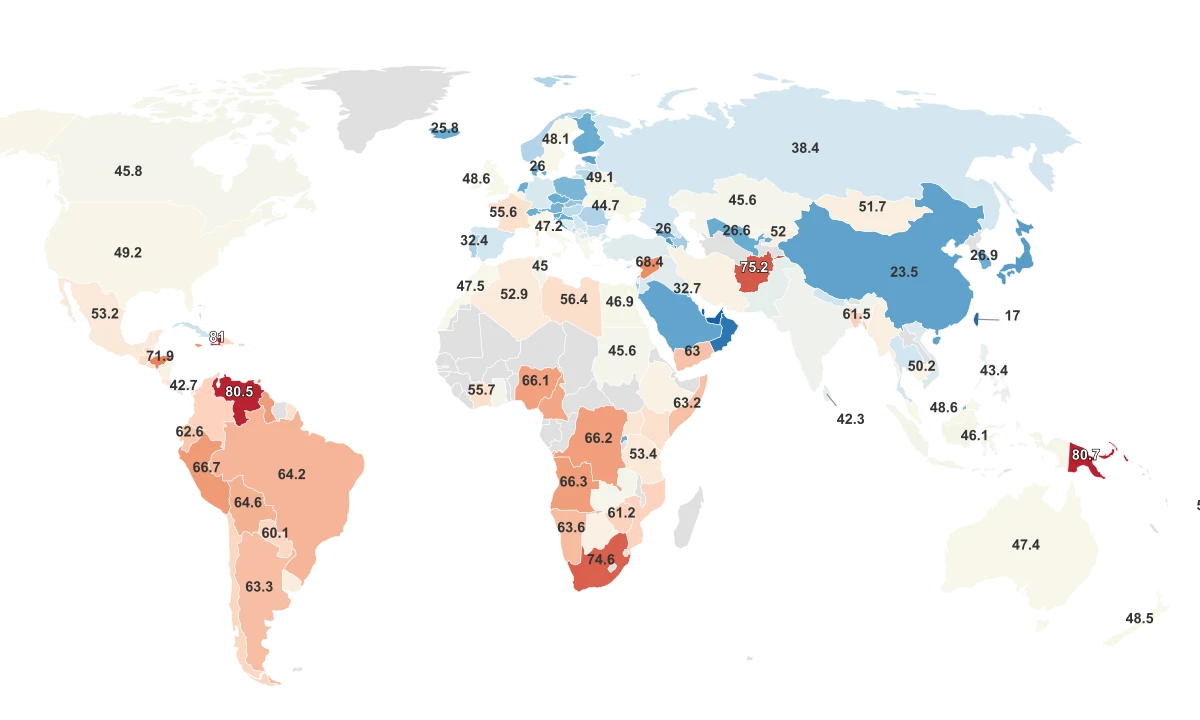
The single most important thing to know about a "crime rate by country" ranking is which number you are reading, and this one is a measure of fear. On the 2025 Crime Index, Haiti scores highest at 81 out of 100, while the United Arab Emirates scores lowest at 14.8; a higher number means residents perceive more crime, not that a government counted more of it. The figure comes from Numbeo, which builds the index from surveys answered by website visitors and scales their responses from 0 to 100.
That provenance matters because Numbeo itself notes the index is "based user-contributed perceptions, which may differ from official government statistics." It captures how safe people feel walking home, how worried they are about theft or assault, and how much disorder they see around them. Papua New Guinea (80.7) and Venezuela (80.5) sit just below Haiti at the top, while most of the world clusters in the middle of the scale and a short run of wealthy states anchors the bottom.
The Countries That Feel Dangerous Are Not Always the Deadliest
A reader who assumes the scariest-feeling countries are also where people are most likely to be killed will find the official record argues otherwise. Papua New Guinea and Venezuela rank near the very top of perceived crime, yet their recorded homicide rates, roughly 9 and 13 per 100,000, are a fraction of the figures the United Nations Office on Drugs and Crime reports for Jamaica (about 49), Ecuador (about 46), and South Africa (about 44). The places that feel the most dangerous and the places that record the most killing are overlapping but distinct lists.
Feeling Unsafe and Getting Killed Are Loosely Linked, Not the Same
Perceived crime and recorded homicide rise together across 139 countries, but many nations sit far off the line in both directions.
The two measures do move in the same general direction. Across the 139 countries with both figures, higher perceived crime broadly tracks higher recorded homicide, which is why the Caribbean and Latin America crowd the upper half of both. UNODC attributes that concentration to organized crime, which its 2023 study finds "is driving homicide trends in Latin America and the Caribbean," a region it identifies as facing "a higher risk of intentional killings than any other." But the relationship is loose, not lockstep. France illustrates the inverse case, carrying a fairly high perception score of 55.6 over a homicide rate near 1.3 per 100,000, while the United States, often imagined as violent, sits below the global midpoint of perceived crime at 49.2.
If It Isn't Murder Driving the Fear, What Is
If recorded killing only partly explains the perception score, the natural question is what fills the gap. Statistically, the homicide rate accounts for only about a third of where a country falls on the Crime Index, which leaves most of the score to other forces. Those are the things the index was built to capture in the first place: visible street disorder, property crime and theft, harassment, and a general distrust that a wealthy, tightly policed microstate like the United Arab Emirates or Qatar can suppress in a way a fragile state cannot.
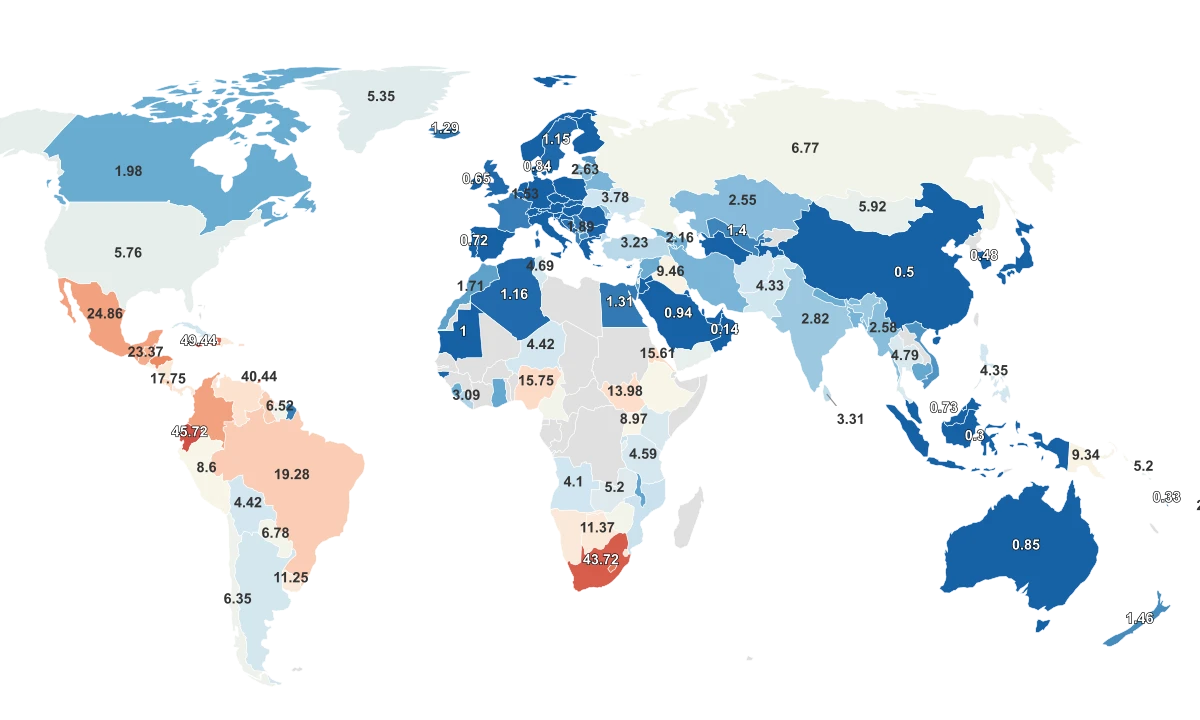
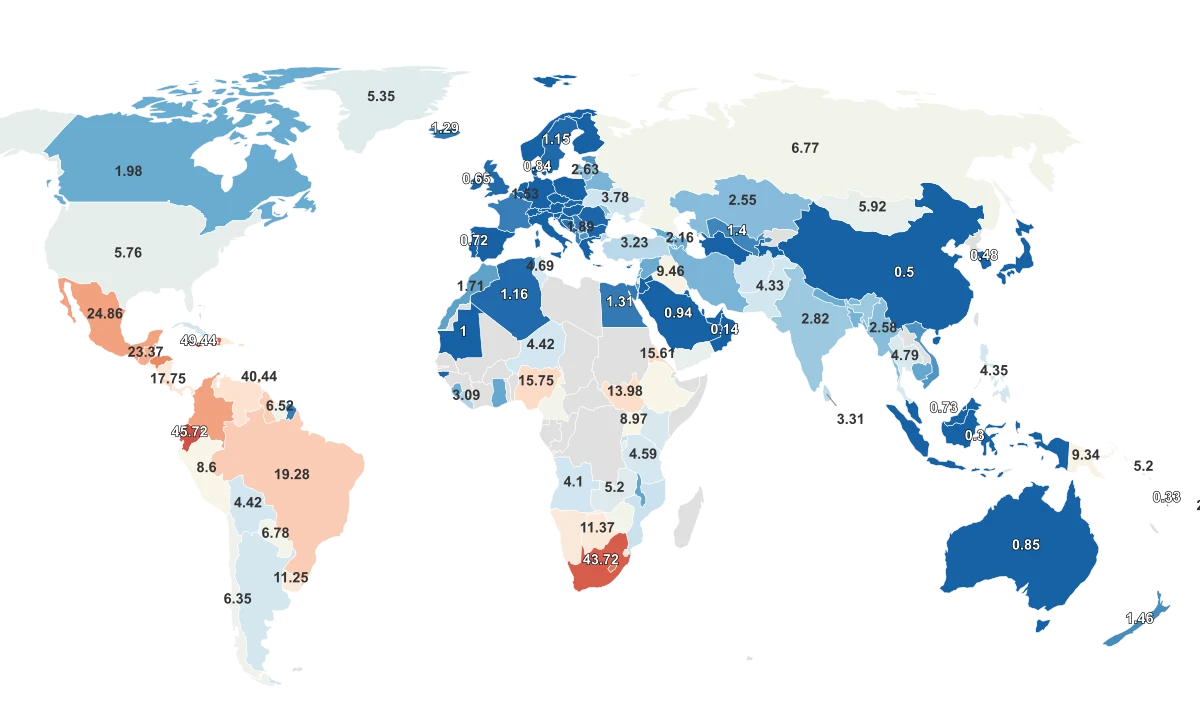
This is also why a third crime statistic on this dataset, the recorded rape rate, cannot be read as a danger ranking at all. Its highest reported figures belong to Botswana, Switzerland, and Sweden, and its lowest to Lebanon and Saudi Arabia, an ordering that reflects legal definitions and reporting culture far more than incidence. Researchers surveying the UNODC series warn that "inconsistent definitions of rape, different rates of reporting, recording, prosecution and conviction" make the counts "unreliable or misleading," and Sweden in particular records "one offence for each person raped" on every separate occasion, mechanically lifting its count above peers. A high number there signals that victims are believed and crimes are logged, not that a country is more dangerous.
Behind a Flat Global Average, Countries Swung Hard
A glance at the global average suggests nothing changed: across every country measured, the Crime Index barely moved between 2021 and 2025. That calm is misleading, stitched together from large national moves pulling in opposite directions. Paraguay swung the hardest upward, its perceived-crime score climbing about 22 percent and lifting it roughly 18 places up the table, with Ecuador rising about 13 percent close behind.
Paraguay's Sense of Safety Eroded the Fastest
Perceived crime climbed about 22 percent there between 2021 and 2025, even as the global average held flat.
Showing 51 of 135 regions · Sorted by: Highest to Lowest · 84 not shown
The movement ran both ways. El Salvador posted the largest absolute drop, its score falling about 11 points over the same span, a reversal large enough to reshape how its residents rate their own safety. The lesson of the time series is the lesson of the whole page: a single global "crime rate" averages away exactly the national stories a reader came to understand, which is why the country-by-country view, and the distinction between what is felt and what is recorded, carries the real information.
Sources & Notes
Reflects perceived levels of crime, based on types and frequency of crimes.
Rate per 100,000 people.
Editorial Note: Due to variations in international reporting infrastructure, this dataset reflects the most recent reporting year available for each respective country provided by the UNODC.
Annual number of reported rape cases per 100,000 people.