Most Visited Countries

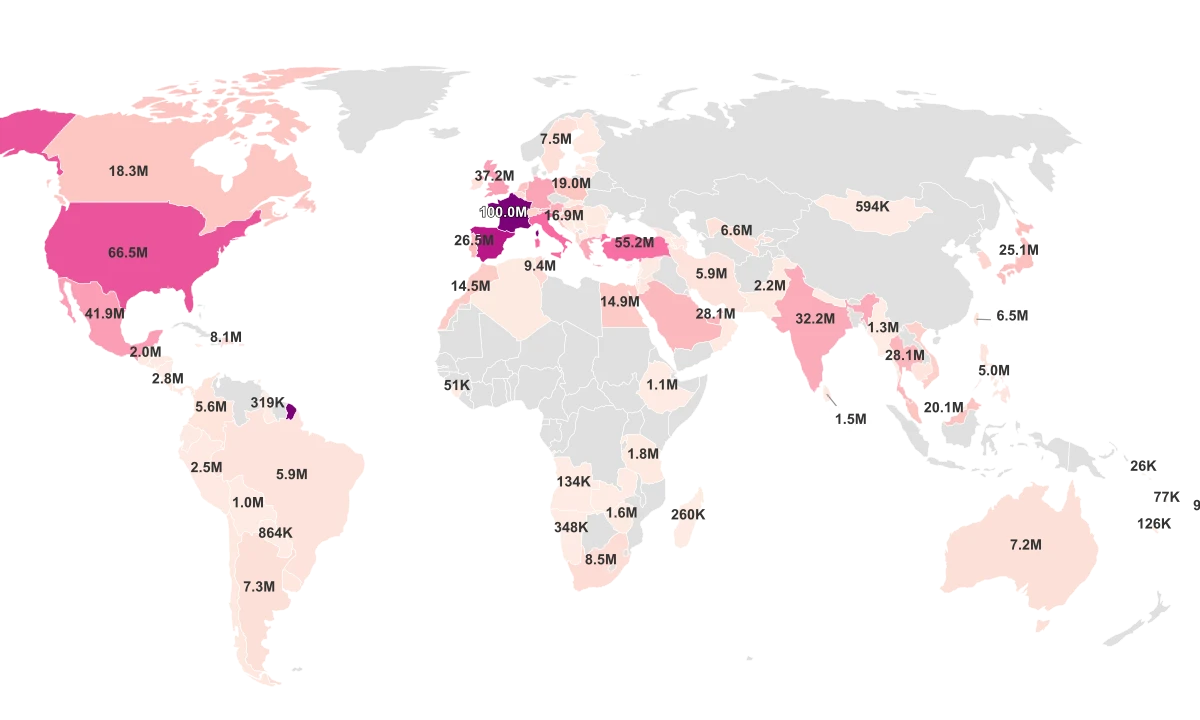
1— |  | France | 100M+6.8M (+7.3%) |
2— |  | Spain | 85,169,000+13.5M (+19%) |
3— |  | United States | 66,482,000+15.7M (+31%) |
4▲1 |  | Italy | 57,250,000+7.4M (+15%) |
5▼1 |  | Turkey | 55,159,000+4.7M (+9.3%) |
6— |  | Mexico | 41,949,000+3.6M (+9.5%) |
7— |  | United Kingdom | 37,215,000+6.5M (+21%) |
8— |  | Germany | 34,801,000+6.3M (+22%) |
9— |  | Greece | 32,735,000+4.9M (+18%) |
10▲7 |  | India | 32,209,000+17.9M (+125%) |
11▼1 |  | Austria | 30,910,000+4.7M (+18%) |
12▲10 |  | Thailand | 28,150,000+17.1M (+154%) |
13▼2 |  | United Arab Emirates | 28,146,000+5.5M (+24%) |
14▼1 |  | Saudi Arabia | 27,424,000+10.8M (+65%) |
15▼3 |  | Portugal | 26,535,000+4.3M (+19%) |
16▲27 |  | Japan | 25,066,000+21.2M (+554%) |
17▼3 |  | Netherlands | 20,303,000+4.2M (+26%) |
18▲7 |  | Malaysia | 20,142,000+10.1M (+100%) |
19▼4 |  | Poland | 18,987,000+3M (+19%) |
20▼1 |  | Canada | 18,344,000+5.5M (+43%) |
21▲86 |  | Hong Kong | 17,159,000+16.6M (+2921%) |
22▼6 |  | Croatia | 16,855,000+1.5M (+10.0%) |
23▼2 |  | Egypt | 14,905,000+3.2M (+28%) |
24▼1 |  | Morocco | 14,525,000+3.7M (+34%) |
25▲30 |  | Macau | 14,227,000+11.7M (+473%) |
26▼6 |  | Hungary | 12,934,000+285K (+2.3%) |
27▲19 |  | Vietnam | 12,602,000+8.9M (+244%) |
28▼2 |  | Switzerland | 11,561,000+2.4M (+26%) |
29▲22 |  | South Korea | 11,032,000+7.8M (+245%) |
30▼2 |  | Albania | 9,670,000+2.5M (+35%) |
31▲1 |  | Tunisia | 9,371,000+2.9M (+46%) |
32▼5 |  | Belgium | 9,280,000+1.1M (+13%) |
33— |  | South Africa | 8,483,000+2.8M (+49%) |
34▼5 |  | Dominican Republic | 8,059,000+896K (+13%) |
35▼4 |  | Sweden | 7,531,000+902K (+14%) |
36▲6 |  | Argentina | 7,286,000+3.4M (+87%) |
37▲8 |  | Australia | 7,187,000+3.5M (+95%) |
38▼3 |  | Uzbekistan | 6,626,000+1.4M (+27%) |
39▲55 |  | Taiwan | 6,487,000+5.6M (+624%) |
40— |  | Ireland | 6,300,000 |
41▲7 |  | Brazil | 5,908,000+2.3M (+63%) |
42▼2 |  | Iran | 5,868,000+1.8M (+43%) |
43▼6 |  | Colombia | 5,631,000+1.1M (+25%) |
44— |  | Bahrain | 5,556,000+1.8M (+50%) |
45▲14 |  | Cambodia | 5,453,000+3.2M (+139%) |
46▼8 |  | Jordan | 5,345,000+1.1M (+25%) |
47▼8 |  | Puerto Rico | 5,046,000+814K (+19%) |
48▲5 |  | Philippines | 5,003,000+2.3M (+89%) |
49▼2 |  | Georgia | 4,669,000+1M (+28%) |
50▼9 |  | Slovenia | 4,658,000+722K (+18%) |
51▲3 |  | Qatar | 4,054,000+1.5M (+58%) |
52▼3 |  | Andorra | 4,048,000+493K (+14%) |
53— |  | Bulgaria | 4,032,000 |
54▼4 |  | Cyprus | 3,846,000+645K (+20%) |
55▲1 |  | Uruguay | 3,835,000+1.4M (+55%) |
56▲10 |  | Chile | 3,731,000+1.7M (+84%) |
57▼5 |  | Israel | 3,010,000+335K (+13%) |
58— |  | Malta | 2,976,000+689K (+30%) |
59— |  | Jamaica | 2,876,000 |
60▲4 |  | Oman | 2,849,000+743K (+35%) |
61▼4 |  | Costa Rica | 2,751,000+401K (+17%) |
62▲1 |  | Finland | 2,561,000+434K (+20%) |
63▲4 |  | Peru | 2,525,000+516K (+26%) |
64▲5 |  | El Salvador | 2,479,000+588K (+31%) |
65— |  | Montenegro | 2,447,000+411K (+20%) |
66▼4 |  | Estonia | 2,422,000+256K (+12%) |
67▼6 |  | Lithuania | 2,405,000+236K (+11%) |
68▲6 |  | Armenia | 2,317,000+651K (+39%) |
69▼1 |  | Pakistan | 2,215,000+297K (+15%) |
70▲16 |  | Algeria | 2,196,000+950K (+76%) |
71— |  | Serbia | 2,134,000+361K (+20%) |
72▲3 |  | Romania | 2,101,000+440K (+26%) |
73▲4 |  | Guatemala | 2,021,000+527K (+35%) |
74▼4 |  | Syria | 2,018,000+231K (+13%) |
75▼2 |  | Maldives | 1,879,000+204K (+12%) |
76▲2 |  | Panama | 1,874,000+382K (+26%) |
77▲6 |  | Bahamas | 1,806,000+353K (+24%) |
78▲4 |  | Tanzania | 1,805,000+350K (+24%) |
79▲1 |  | Lebanon | 1,666,000+200K (+14%) |
80▲10 |  | Zimbabwe | 1,603,000+559K (+54%) |
81— |  | Slovakia | 1,600,000 |
82▲18 |  | Sri Lanka | 1,487,000+767K (+107%) |
83▲2 |  | Ecuador | 1,427,000+162K (+13%) |
84▲5 |  | Azerbaijan | 1,403,000+345K (+33%) |
85▲7 |  | Mauritius | 1,295,000+298K (+30%) |
86▲41 |  | Myanmar | 1,285,000+1.1M (+452%) |
87— |  | Latvia | 1,277,000 |
88▼1 |  | Aruba | 1,260,000+159K (+14%) |
89▲4 |  | Bosnia and Herzegovina | 1,199,000+291K (+32%) |
90▲7 |  | Nicaragua | 1,087,000+269K (+33%) |
91▲5 |  | Ethiopia | 1,078,000+238K (+28%) |
92▼1 |  | Luxembourg | 1,063,000+50K (+4.9%) |
93▲11 |  | Nepal | 1,015,000+401K (+65%) |
94▲5 |  | Bolivia | 1,009,000+285K (+39%) |
95▲3 |  | Cape Verde | 962,000+177K (+23%) |
96▲6 |  | Fiji | 930,000+294K (+46%) |
97▲8 |  | Paraguay | 864,000+285K (+49%) |
98▼3 |  | Honduras | 850,000+6,000 (+0.7%) |
99▼11 |  | Zambia | 801,000-260K (-25%) |
100▲10 |  | North Macedonia | 734,000+197K (+37%) |
101▲2 |  | Turks and Caicos Islands | 663,000+47K (+7.6%) |
102▲19 |  | Guam | 656,000+328K (+100%) |
103▲6 |  | Barbados | 637,000+97K (+18%) |
104▲20 |  | Mongolia | 594,000+308K (+108%) |
105▲8 |  | Curacao | 582,000+92K (+19%) |
106— |  | Rwanda | 564,000 |
107▲5 |  | Reunion | 556,000+61K (+12%) |
108▲10 |  | Palestine | 483,000+121K (+33%) |
109▲7 |  | Belize | 465,000+92K (+25%) |
110▲15 |  | Cayman Islands | 429,000+145K (+51%) |
111▲5 |  | Sint Maarten | 395,000+22K (+5.9%) |
112▲7 |  | Saint Lucia | 381,000+25K (+7.0%) |
113▲7 |  | Seychelles | 351,000+19K (+5.7%) |
114— |  | Namibia | 348,000-113K (-25%) |
115▲8 |  | Guyana | 319,000+31K (+11%) |
116▲12 |  | Trinidad and Tobago | 309,000+83K (+37%) |
117▲9 |  | Antigua and Barbuda | 282,000+17K (+6.4%) |
118▲11 |  | French Polynesia | 262,000+44K (+20%) |
119▲11 |  | British Virgin Islands | 261,000+88K (+51%) |
120▲15 |  | Madagascar | 260,000+128K (+97%) |
121— |  | Northern Mariana Islands | 216,000 |
122▲10 |  | Moldova | 195,000+33K (+20%) |
123▲10 |  | Bermuda | 185,000+39K (+27%) |
124▲7 |  | Samoa | 169,000 |
125▲13 |  | Cook Islands | 144,000+30K (+26%) |
126▲8 |  | Brunei | 134,000 |
126— |  | Angola | 134,000 |
128▲13 |  | New Caledonia | 126,000+46K (+57%) |
129▲11 |  | Liechtenstein | 114,000+13K (+13%) |
130▲9 |  | San Marino | 109,000-1,000 (-0.9%) |
131▲10 |  | Saint Kitts and Nevis | 104,000+24K (+30%) |
132▲11 |  | Anguilla | 96,000+22K (+30%) |
133▲13 |  | Saint Vincent and the Grenadines | 81,000+22K (+37%) |
134▲13 |  | Vanuatu | 77,000+47K (+157%) |
135▲10 |  | Dominica | 68,000+7,000 (+11%) |
136▲8 |  | Sierra Leone | 51,000-20K (-28%) |
137— |  | Palau | 41,000 |
138▲10 |  | Solomon Islands | 26,000 |
139▲10 |  | Montserrat | 8,000+3,000 (+60%) |
Last updated June 25, 2026
Key Takeaways
- France drew the most international visitors in 2023, the only country to reach 100.0 million arrivals.
- The smallest count in this 139-country dataset belongs to Montserrat, at roughly 8,000 arrivals.
- Just five countries took in close to a third of every arrival counted worldwide.
- The most visited country is not the one that earns the most: the United States ranks third on visitors but first on tourism revenue, by a wide margin.
All Metrics
France Crossed 100 Million Visitors in 2023. No One Else Came Close.
In 2023, France welcomed 100.0 million international visitors, more than any other country and the only one to clear the 100 million line. Spain came next at 85.2 million, and the United States third at 66.5 million. At the far end of the table, the smallest count in this 139-country dataset belongs to Montserrat, at roughly 8,000 arrivals.
These figures come from UN Tourism, the United Nations agency that compiles each country's tourism statistics into a single 2023 series. One detail changes how the whole table should be read: an arrival counts a trip, not a person. As the World Bank's methodology glossary puts it, the data refer to "the number of arrivals, not to the number of people traveling," so a repeat visitor is counted each time. A higher number means more visitor trips, not a better or more desirable country.
One more piece of context matters before reading further. 2023 was a recovery year, not a settled one. Global travel was climbing back from the pandemic but had not yet returned to where it stood before, a gap the later sections make concrete. UN Tourism has since reported that 2024 brought the world close to full recovery, so these 2023 standings are a snapshot of a world still catching its breath.
A Few Countries Hold Most of the World's Tourists
Global tourism looks less like a crowded field than a short head table with a very long room behind it. The five busiest destinations, France, Spain, the United States, Italy, and Turkey, together took in 31.28% of every international arrival counted in 2023. Five countries, close to a third of the world's visitors.
The rest of the world sits far below those headline numbers. The typical country in the dataset drew about 2.2 million arrivals, while the average lands near 8.4 million, lifted well above the middle by the handful of giants at the top. Most destinations are nowhere near France's hundred million; they are clustered down in the low millions, and many small island territories count their visitors in the thousands.
That top-heaviness has a structural cause. Europe is the world's largest destination region, carrying roughly 56% of global arrivals, and much of that traffic flows across open internal borders within the Schengen area. A compact continent of neighboring countries, where the metric logs every border crossing, mechanically piles up enormous arrival totals. The same few names dominate the money side too: the top five earners hold a comparable 32.68% of all tourism receipts, a concentration of revenue distinct from the arrivals figure but pointing at the same short list of countries.
The Money Doesn't Follow the Crowds
It is tempting to assume the country with the most visitors also makes the most money from them. Mostly, that holds. Arrivals and tourism revenue move together closely, and a country's revenue alone explains about two-thirds of the differences in how many visitors it draws, across the 116 countries that report both. The crowd and the cash usually travel together.
At the very top, though, the order breaks. The United States ranks third on visitors but first on tourism revenue by a wide margin, pulling in $189.1 billion in 2023, according to UN Tourism's Highlights. That is more than twice what France earned. Spain shows the same twist in miniature: it out-earned France on tourism, $92.0 billion to $71.2 billion, despite drawing millions fewer visitors.
Part of the gap is built into the count itself. An arrival logs a trip, not the value of that trip, so a border crossing into France registers the same whether the visitor stays three weeks or passes through on the way somewhere else. France is a high-transit country, and the methodology records each inbound trip as one arrival, which lifts a country's visitor tally without necessarily lifting what those visitors leave behind.
More Visitors Usually Means More Money, Until the Very Top
Across 116 countries, arrivals and tourism revenue rise together, but the United States sits far off the line, earning more than its visitor count would predict.
Who's Rising and Who Hasn't Come Back
The leaderboard looks stable from the top, but underneath it the rankings were still in motion in 2023. Global arrivals that year remained about 4.5% below their 2018 level, so the headline standings describe a world mid-rebound rather than fully back. Who climbed and who stalled depended largely on how fast a region reopened its borders.
The fastest climbers were in the Gulf and South Asia. Saudi Arabia roughly doubled its visitor count against 2018 and rose 17 spots, the biggest jump in the dataset. The United Arab Emirates climbed 13 places, and India climbed 12. These are not marginal shifts; they reflect destinations that aggressively courted travelers while older markets were still finding their footing.
The Recovery Was Real but Unfinished by 2023
Change in international arrivals from 2018 to 2023. Gulf and South Asian destinations surged ahead while several Asian stalwarts stayed below where they started.
Several long-established Asian destinations had not yet returned. Hong Kong sat about 28% below its 2018 arrivals, Thailand roughly 29% below, and Japan about 22% below. The cause was timing, not lost appeal: Asia and the Pacific dropped pandemic border restrictions far later than Europe, and the region recovered only about 62% of its pre-pandemic arrivals through much of 2023, with North-East Asia lagging furthest. That regional drag has eased since: UN Tourism reports that global arrivals grew again in 2025, though Asia and the Pacific stayed slightly below 2019 levels even then.
Sources & Notes
Annual number of international tourist arrivals.
Revenue generated from international tourists visiting a country.