Moose Population by State

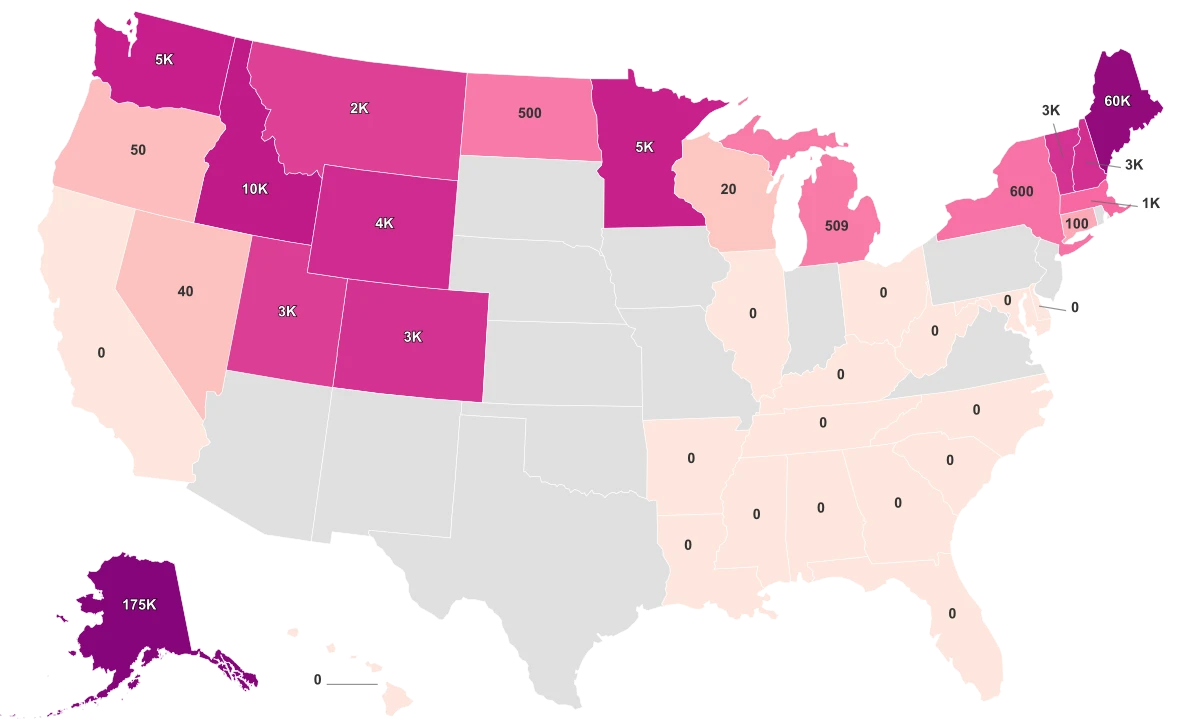
1 |  | Alaska | 175,000 |
2 |  | Maine | 60,000 |
3 |  | Idaho | 10,000 |
4 |  | Washington | 5,000 |
5 |  | Minnesota | 4,700 |
6 |  | Wyoming | 3,500 |
7 |  | New Hampshire | 3,300 |
8 |  | Colorado | 3,000 |
8 |  | Vermont | 3,000 |
10 |  | Utah | 2,500 |
11 |  | Montana | 2,334 |
12 |  | Massachusetts | 1,000 |
13 |  | New York | 600 |
14 |  | Michigan | 509 |
15 |  | North Dakota | 500 |
16 |  | Connecticut | 100 |
17 |  | Oregon | 50 |
18 |  | Nevada | 40 |
19 |  | Wisconsin | 20 |
20 |  | Hawaii | 0 |
20 |  | Delaware | 0 |
20 |  | Mississippi | 0 |
20 |  | Alabama | 0 |
20 |  | Maryland | 0 |
20 |  | Tennessee | 0 |
20 |  | Florida | 0 |
20 |  | South Carolina | 0 |
20 |  | Louisiana | 0 |
20 |  | Kentucky | 0 |
20 |  | North Carolina | 0 |
20 |  | Illinois | 0 |
20 |  | Ohio | 0 |
20 |  | Arkansas | 0 |
20 |  | West Virginia | 0 |
20 |  | Georgia | 0 |
20 |  | California | 0 |
Last updated February 28, 2026
Moose Populations Across the U.S.
Moose are the largest members of the deer family and one of North America’s most distinctive species. Yet their presence in the United States is confined to colder, forested regions where they can thrive. According to data from state wildlife agencies and the U.S. Fish and Wildlife Service, the national moose population exceeds 250,000, with nearly 70% of all moose living in Alaska alone.
Outside Alaska, the species is concentrated in Maine, Idaho, Washington, and Minnesota, while smaller herds inhabit the northern Rockies and New England. In most southern states, moose are absent due to climate and habitat unsuitability. Population health varies widely—some regions have seen decades of recovery through reintroduction efforts, while others struggle with declines linked to parasites and warming temperatures.
Northern states like Maine, Vermont, and New Hampshire benefited from forest regeneration after 20th-century logging, which created ideal moose habitat. Colorado and Utah successfully reintroduced moose in the 1970s and 1980s, leading to stable modern herds.
By contrast, Minnesota’s moose population has fallen by over 60% since the early 2000s, mainly due to winter tick infestations and brainworm, both exacerbated by warmer winters. The Rocky Mountain populations in Idaho, Wyoming, and Montana remain relatively stable, though wildlife agencies continue to monitor for habitat loss and predator impact.
As an indicator species for northern ecosystem health, moose reflect broader trends in climate, forest succession, and biodiversity across North America.
All Metrics
| Region ↕ | Moose Population Count 2024↕ | Moose Sighting Frequency Rating 2024↕ |
|---|---|---|
| Alaska | 175,000 | |
| Maine | 60,000 | |
| Idaho | 10,000 | |
| Washington | 5,000 | |
| Minnesota | 4,700 | |
| Wyoming | 3,500 | |
| New Hampshire | 3,300 | |
| Colorado | 3,000 | |
| Vermont | 3,000 | |
| Utah | 2,500 | |
| Montana | 2,334 | |
| Massachusetts | 1.0K | |
| New York | ||
| Michigan | ||
| North Dakota | ||
| Connecticut | ||
| Oregon | ||
| Nevada | ||
| Wisconsin | ||
| Hawaii | ||
| Delaware | ||
| Mississippi | ||
| Alabama | ||
| Maryland | ||
| Tennessee | ||
| Florida | ||
| South Carolina | ||
| Louisiana | ||
| Kentucky | ||
| North Carolina | ||
| Illinois | ||
| Ohio | ||
| Arkansas | ||
| West Virginia | ||
| Georgia | ||
| California |
Key Findings
- Alaska dominates with about 175,000 moose, representing the vast majority of the national population.
- Maine follows distantly with around 60,000, the largest population in the contiguous U.S.
- Idaho (10,000), Washington (5,000), and Minnesota (4,700) round out the top five.
- Southern and coastal states such as Florida, Georgia, Alabama, and Mississippi report no moose presence.
- New England remains a stronghold, with New Hampshire, Vermont, and Massachusetts sustaining stable herds and frequent sightings.
- Sightings vary from “frequent” in northern states to “nonexistent” across the South.
- Climate change, parasites, and forest management continue to shape moose distribution and density.
States with the Largest Moose Populations
Alaska ranks 1st with 175,000 moose, accounting for most of the U.S. total. Maine ranks 2nd with 60,000, leading all Lower-48 states. Idaho places 3rd with 10,000, while Washington (4th, 5,000) and Minnesota (5th, 4,700) complete the top five. New Hampshire (6th, 3,300) and Vermont (7th, 3,000) host the densest populations in the Northeast. Wyoming (8th, 3,500), Colorado (9th, 3,000), and Massachusetts (10th, 1,000) maintain smaller but stable herds, supported by suitable forest and wetland habitats.
Top 10 States by Moose Population
| Rank | State | Estimated Moose Count | Sighting Frequency |
|---|---|---|---|
| 1 | Alaska | 175,000 | Frequent |
| 2 | Maine | 60,000 | Frequent |
| 3 | Idaho | 10,000 | Common |
| 4 | Washington | 5,000 | Common |
| 5 | Minnesota | 4,700 | Common |
| 6 | New Hampshire | 3,300 | Common |
| 7 | Vermont | 3,000 | Common |
| 8 | Wyoming | 3,500 | Common |
| 9 | Colorado | 3,000 | Common |
| 10 | Massachusetts | 1,000 | Occasional |
Where Moose Are Rare or Absent
Moose are nonexistent across most southern and coastal states — including Florida, Alabama, Mississippi, Georgia, South Carolina, and Louisiana — due to unsuitable climates and lack of boreal forest habitat.
In states like Nevada, Texas, and Pennsylvania, moose appear only rarely or very rarely, typically as strays wandering from northern populations. Occasional reports from Connecticut, New York, and Michigan reflect transient individuals rather than permanent herds.
Wildlife biologists caution that isolated sightings in these regions do not indicate a sustainable presence but highlight the species’ wide dispersal potential.
Sources & Notes
Estimated total number of moose in the state Frequency rating of moose sightings in the state.